Posted on 19th March 2026 | Modified on 26th March 2026
Military/Aerospace Electronics, News, Testing
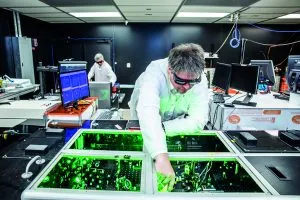
Cosmic radiation is an invisible threat that can be countered with laser-driven accelerator technology, says Manuel Hegelich. The space industry faces an invisible enemy that threatens every mission from Earth orbit to Mars and beyond: cosmic radiation. Space radiation Modern electronics face unprecedented vulnerability to space radiation. As transistors shrink below 10nm, even low-energy particles can cause single-event effects (SEEs). ...
Posted on 19th March 2026 | Modified on 26th March 2026
Military/Aerospace Electronics, News
Forward error correction in aerospace fibre optic systems necessitates trade-offs when implementing it in next-generation architectures, says Grover Brower. As aerospace platforms evolve to support more data-intensive capabilities, ranging from real-time video and sensor fusion to advanced radar, traditional data buses such as MIL-STD-1553 are no longer sufficient. Their low throughput and legacy architecture cannot keep pace with mission-critical systems ...
Posted on 19th March 2026 | Modified on 26th March 2026
News
Roger Kauffman looks ahead to what faster wireless communication and increased capacity will mean for productivity. With 6G technology being in the early stages of development and research, a new chapter in wireless connectivity is on the horizon. 6G offers the promise of faster speeds, ultra-low latency and massive capacity upgrades. While the rollout of this technology is still several ...
Posted on 18th March 2026 | Modified on 26th March 2026
News, World Region - Europe
As well as welcoming holidaymakers, the Canary Islands is home to a thriving electronics and industrial community. Ash Madni profiles three entrepreneurs behind some of the islands’ technology leaders. There are a dozen electronics companies on the Canary Islands. The president of the special tax zone, Pablo Hernández González-Barreda, and his team have created a rising production hub for the ...
Posted on 18th March 2026 | Modified on 26th March 2026
News, World Region - America
Building out the US semiconductor workforce pipeline: what can be done for the future? By Robert Quinn and Dr Ariful Haque. The CHIPS and Science Act led to investment to the tune of $53bn in US federal funding to help revitalise the US semiconductor industry. With the US’s worldwide share of chip manufacturing capacity declining from 37% in 1990 to ...
Posted on 22nd February 2026 | Modified on 24th February 2026
Uncategorised
Sign up for the Mannerisms, Gadget Master, the Daily and the main Weekly newsletter.
Posted on 19th February 2026 | Modified on 26th February 2026
AI, News, Sensors
By transforming performance data into actionable insights through edge processing, sports tracking solutions will help athletes, coaches and teams reach their full potential, says Thomas Søderholm. In today’s world of sport, the difference between winning and losing can come down to the finest of margins. Results are routinely decided by milliseconds, millimetres or blink-and-you-missed-it moments. Yet even precise metrics such ...
Posted on 19th February 2026 | Modified on 26th February 2026
AI, News
Autonomous systems are moving beyond simple, pre-programmed tasks, enabled by advances in AI models and processing, says Sophie Yang. From logistics to manufacturing and from healthcare to smart buildings applications, machines are expected not just to follow instructions, but to adapt, perceive and make decisions in highly dynamic environments. A strong example of this physical AI is the rise of ...
Posted on 19th February 2026 | Modified on 26th February 2026
Internet of Things, News
As the IoT has evolved and changed, so have the requirements for efficient performance and security, says Nick Wood. IoT, or internet of things, is a vague term, but the most general definition would be devices that talk to each other without human directed intervention. Early implementations were typically just adding connectivity to previously standalone electronic apparatus. Often these connections ...
Posted on 18th February 2026 | Modified on 26th February 2026
AI, News
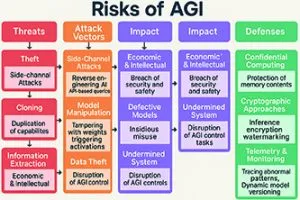
Securing artificial general intelligence means protecting the future of intelligence itself, urges Sesi Bommana. In the race to develop artificial general intelligence (AGI), most of the focus has been on scaling: building larger models, utilising more data and deploying bigger clusters. As capabilities grow, another critical question arises: what if someone steals the AGI model? Unlike traditional software breaches or ...