Nvidia is to invest $2 billion in Marvell to ensure that Marvell’s customers for datacentre ASICs have a route to compatibility with Nvidia’s computing platform. With the hyperscalers developing their own ASIC custom silicon for datacentres, as an alternative to buying Nvidia GPUs, Nvidia aims to ensure that Marvell’s custom chips can remain compatible with Nvidia’s datacentre hardware. Marvell is currently ...
AI
Artificial Intelligence (AI) is revolutionizing electronics design, automation, and data processing. Recent developments in machine learning (ML), computer vision, and AI-powered systems have enhanced the capabilities of smart devices, autonomous vehicles, and IoT applications. As AI continues to evolve, it is transforming industries like healthcare, telecommunications, and robotics, enabling faster, more intelligent decision-making. AI hardware, including neuromorphic chips and AI accelerators, is pushing the limits of processing power and efficiency. With Generative AI’s increasing global presence, it remains a driving force behind the development of future technologies across all sectors.
Mistral raises $830m
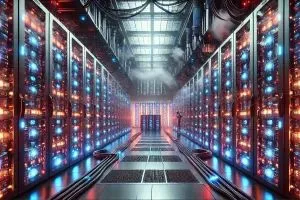
Mistral AI, the French AI developer, says it has taken on debt of $830 million to run a datacentre. The datacentre, at Bruyeres-le-Chatel near Paris, is used to train of AI models using 13,800 Nvidia GB300 AI ICs, with operations expected to start in Q2. The $830 million has been borrowed from a consortium of banks including: HSBC, Mitsubishi UFJ, ...
Starcloud raises $170m; plans to put 88,000 datacentre satellites in LEO
Two-year-old startup Starcloud has raised $170m at a $1.1bn valuation to put datacentres in space. “By moving AI compute to space, we unlock access to unlimited solar power and completely remove the energy bottleneck,” says Philip Johnston, co-founder and CEO of Starcloud, who is an alumnus of Imperial College. Investors were: Benchmark, EQT Ventures, Macquarie Capital, NFX, Nebular, Y Combinator, ...
New sectors for virtual book library: AI, Python, Web, Ghidra
Only bits and bytes they may be, but the Gadget Master virtual library continues to accumulate new entries. A new sector for data storage is required...
Imec gives lifetime achievement award to Jensen Huang
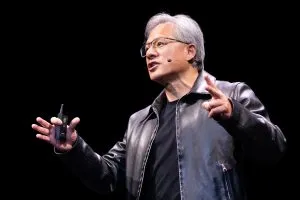
Imec has given Jensen Huang, founder and CEO of Nvidia, its 2026 Lifetime of Innovation Award. The honour recognises Huang’s instrumental role in enabling accelerated computing technologies and empowering critical AI applications across industries – fuelled by the invention of the GPU. The award ceremony, including a video interview with Huang, will be held on 19 May, during imec’s ITF ...
Q4 cloud spend up 29% y-o-y
Q4 spending on cloud infrastructure services reached $110.9bn, led by AWS, MS and Google, for y-o-y growth of 29%, says Omdia. Q4 was the sixth consecutive quarter in which the market expanded by more than 20%. Omdia forecasts that 2026 cloud infrastructure services spending will grow by 27%. During Q4, AWS’s growth accelerated to 24%, while Microsoft Azure and Google ...
CrossSense AI smart glasses scoop £1m Longitude Prize on Dementia
CrossSense, and its AI smart glasses, has been announced as the winner of the Longitude Prize on Dementia. This will see the company scoop a £1 million prize which aims to promote innovation to support sufferers of the syndrome.
CHIIPS #29 – AI in orbit from Dr Rajan Bedi of Spacechips
Don't miss the latest episode of the excellent Electronics Weekly podcast, CHIIPS. It features Dr Rajan Bedi, CEO and founder of of Spacechips.
AI aims high – how AI boosts satellite monitoring
AI is creeping into orbit and being used to predict where emergency services will be needed, accelerating responses compared to traditional satellite monitoring, said Dr Rajan Bedi, CEO and founder of Spacechips. In the latest episode of Electronics Weekly’s CHIIPs podcast, Bedi explains orbit AI machine learning is a focus for the company which designs and develops hardware for satellites ...
Teradyne’s Omnyx tests PCBA for AI servers
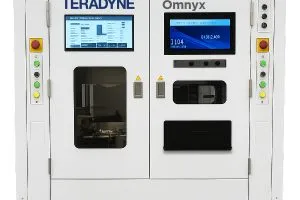
Teradyne is introducing Omnyx, a manufacturing test platform for detecting operational defects in printed circuit board assemblies (PCBA). It’s aimed at AI servers and data center systems and the company says it combines structural, parametric, high-speed interconnect and functional testing. The ideal is to allow manufacturers to identify defects earlier in the production process. This would improve yield and quality ...
Electronics Weekly