Called AVR SD, the devices have 32 or 64kbyte of flash, 4 or 8kbyte of ram and 256 bytes of eeprom, and they come in packaes with 20, 28, 32 or 48pins.
The cores have a hardware multiplier and run up to 20MHz.
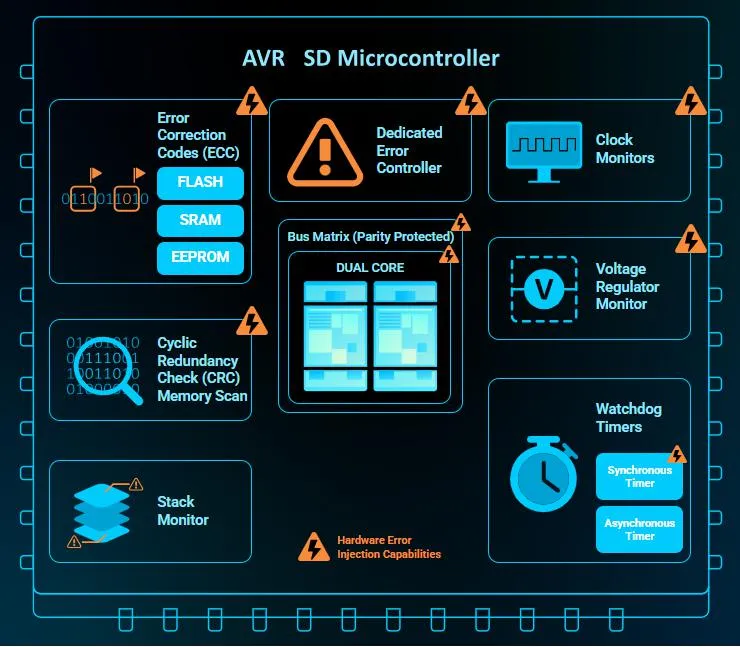
“AVR SD provides a dual-core lockstep CPU, single-Error correcting and double-error detecting error correction on flash, eprom and ram, and programme and debug interface disable for functional safety,” according to Microchip.
Other safety features include dual watchdog timers (synchronous and asynchronous), redundant clock failure detection, clock frequency measurement, parity protection on address, data, control and instruction busses, hardware error injection and twin ADCs with independent voltage references.
To go with the hardware is a software framework designed in compliance with ASIL C and SIL 2 requirements.
“It assists users with a structured application flow, simplifying the addition of user tasks while ensuring device-level safety,” claimed Microchip. “By leveraging this framework, the system integrator can achieve a compliant safety system running on the device.”
Functions include diagnostics for the built-in safety mechanisms, a central software error manager, diagnostic scheduling and error injection mechanisms.
To support development there is functional safety documentation including a safety manual.
Operation is over 2.7 to 5.5V and, depending on the part, over -40 to +85°C or -40 to +125°C.
Electronics Weekly thanks Mouser for bringing these dual core AVR MCUs to its attention. Find them on this Mouser AVR SD web page.