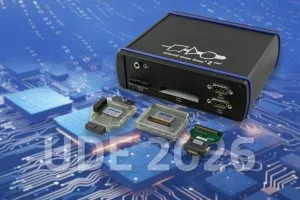
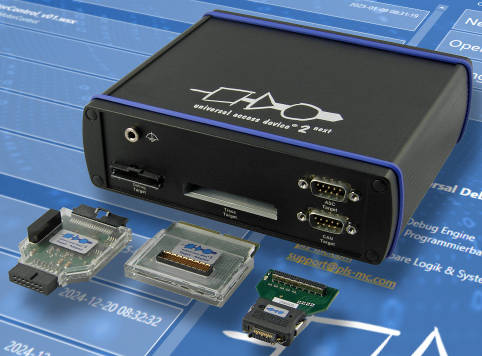
“UDE 2025 comes with a new home screen,” said the company. “Immediately after starting the program, users now have direct access to their most recently used debugger workspaces, sorted by time. Creating a new debugger session now also takes less time.”
Its ‘execution sequence chart’ of executed functions and system tasks has also had some work – it is now possible to search for a specific function by its name, “which is especially helpful when dealing with large amounts of data recorded by trace”, said PLS.
Time axis program flow tracing has been given keyboard shortcuts to speed the tracking of function calls and returns.
For analysis of real-time operating system or Autosar software timing, functions have been asses to send recorded traces and to export functions to Vector or Inchron tools for further processing.
As well as this, UDE functions can now be integrated into GLIWAT’s ‘1.timing’ analysis tool.
Python has been added to JavaScript and Visual Basic as a scripting languages for macro programming.
UDE 2025 now offers multi-core debugging for Tongxin Micro’s THA6 – China’s first ASIL-D certified Arm Cortex-R52 with an integrated Bosch generic timer module (GTM), said PLS.
Alongside the THA6, PLS is promoting this tool for use with Infineon’s recent TC4Dx MCUs, Renesas’ RH850/U2C, NXP’s S32K31, S32K36 and i.MX RT1180, and ST’s SR6 G6 line.
Amongst changes for these processors, the Bosch GTM in RH850/U2B can now be traced and “for the TC4x family, trace support has been extended to the parallel processing unit”, said PLS. “This allows the program flow of the accelerator core for AI applications based on the Synopsys ARC-EV core to be observed in parallel with the TriCore main cores.”
See UDE 2025 for the first time at Embedded World in Nuremberg (11 – 13 March, hall 4, stand 310), or wait for the market launch scheduled in May.