Advanced node foundry is benefiting from strong demand from AI GPU and ASIC customers. TSMC, has raised its 3nm monthly capacity target to 165,000 wafers and CoWoS monthly capacity to 125,000 wafers, with wafer pricing also raised by more than 5%.
Supported by sustained full utilisation at 3nm, the ramp of 2nm, and CoWoS advanced packaging order spillover, TSMC is expected to further expand its foundry market share to 44% in 2026.
.
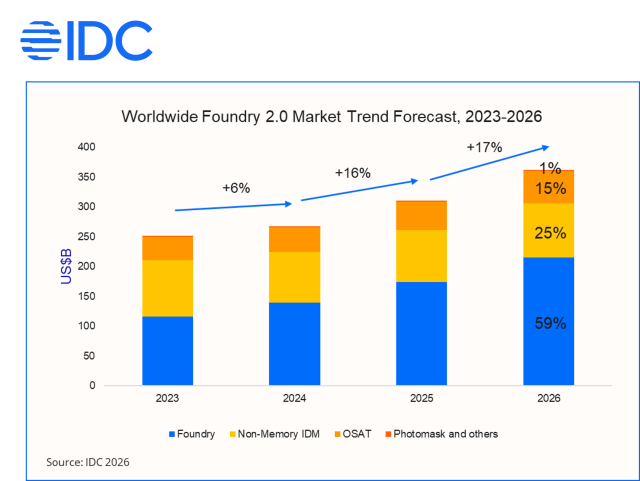
Note: Non-Memory IDM figures primarily reflect manufacturing output value for the segment.
Samsung Foundry is also benefiting from gradually improving SF2 process yields, with the Exynos 2600 mobile processor and cryptocurrency mining chips entering supply, and 4nm HBM4 base die production commencing, driving higher advanced node utilization.
Samsung holds a $16.5 billion long-term agreement with Tesla and has secured orders for AI accelerators including NVIDIA Groq 3 LPU, with order momentum recovering and overall operational trajectory improving.
On the mature node side, as both TSMC and Samsung initiate 8-inch capacity reductions and other mature node players plan 8-inch capacity optimization, global 8-inch total capacity is expected to decline approximately 3% year-over-year in 2026, marking a reversal in supply-demand dynamics.
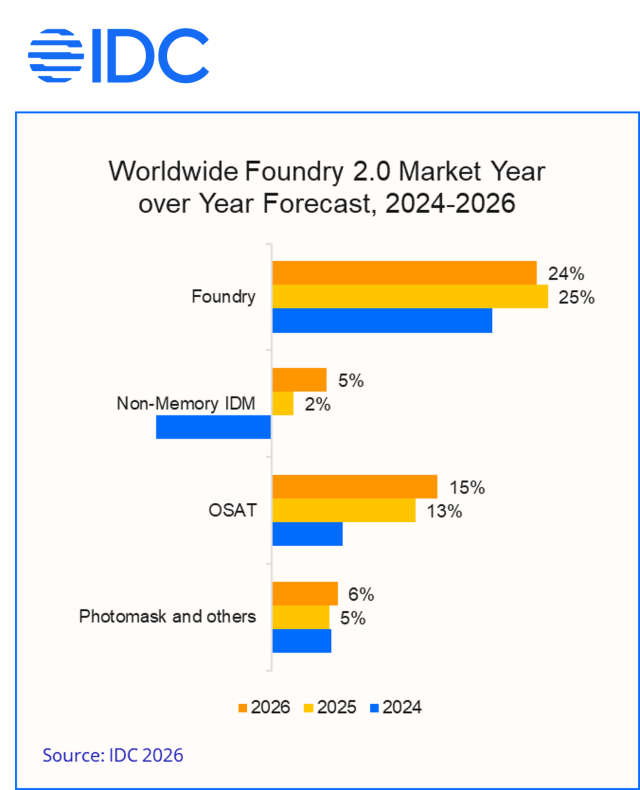
Continued strong demand for server Power ICs and Power Discrete components has prompted select foundries to raise wafer pricing by up to 10%, ending the post-pandemic race-to-the-bottom pricing environment. Overall, IDC forecasts the foundry market to grow 24% year-over-year in 202
The non-memory IDM manufacturing segment is recovering in 2026, with estimated year-over-year growth of 5%.
Intel is accelerating its process roadmap. The Panther Lake processor completed its first volume production shipments in late 2025, and the Clearwater Forest data center processor was officially unveiled at MWC 2026, marking the full entry of the 18A product line into mass production.
Intel’s 12nm collaboration with UMC is actively engaging potential customers for tape-outs, while leading US HPC companies have begun evaluating the 18A-P process.
European automotive IDMs including Infineon, NXP, and STMicroelectronics have completed inventory corrections, with demand expected to gradually recover.
Some players are also adopting “China for China” localised manufacturing as a strategic option to manage geopolitical risk, deepening their presence in the Chinese market through joint ventures or contract manufacturing with domestic fabs.
OSAT is projected to grow 15% year-over-year in 2026, supported by recovery in both advanced and mainstream packaging markets.
The AI chip integration trend continues to elevate the value-add of advanced packaging, with back-end packaging design and system integration now rivaling front-end wafer fabrication in strategic importance.
ASE Technology Holding (ASE) is a key driver of the current AI packaging wave, with growth momentum primarily stemming from sustained CoWoS capacity shortfalls at TSMC and the gradual increase in outsourcing share, driving continued volume ramp in on-substrate packaging (oS) and chip probe (CP).
Post-package test (FT/SLT) and full-process packaging are expected to become the next growth engines, with AI CPU and AI ASIC products progressively entering the pipeline and further expanding ASE’s growth runway in advanced packaging.
Overall, the global OSAT market is benefiting from multiple tailwinds including compute expansion, the proliferation of heterogeneous integration architectures, and the recovery of automotive and industrial end markets.
Rising costs for key packaging materials, including leadframes and substrates, are prompting vendors to renegotiate pricing with customers, pushing overall ASP higher and supporting industry revenue growth. Taiwan and China-based players collectively account for over 70% of global market share, dominating this wave of industry expansion.
“Looking ahead to 2026–2030, the Foundry 2.0 market is projected to achieve a CAGR of 11%, with the long-term capex cycle in AI infrastructure serving as the core engine of sustained industry expansion,” says IDC’s Galen Zeng “however, the ripple effects of semiconductor inflation, the impact of the memory supercycle on downstream end demand, energy supply instability driven by geopolitical conflicts, the evolving policy direction of the US Section 232 investigation, and supply chain restructuring driven by China’s accelerating semiconductor self-sufficiency will all be critical variables shaping the industry’s medium-to-long-term trajectory.”