In the next in our EW BrightSparks of 2025 series, we profile Harry Hill, a student of Electrical and Electronic Engineering at Imperial College London. He is also a UK Electronics Skills Foundation (UKESF) scholar.
Achievements
Throughout his career, Harry told us, he has spent significant time researching ways in which electronics can be used to contribute to sustainable development.
An example of this he shared was his my work on automotive electronics. For example, he led a team of 20 to develop and manufacture an electric car prototype…
The vehicle met sustainability criteria that he had produced from his findings in his submission to the STEMNext essay competition. While composing his essay, he liaised with Johnny Pike, a Senior ESG Analyst at Serica Energy, in which they discussed the need to deploy thousands more charging stations across the UK.
Later, Harry applied the knowledge from this project at his internship at OnSemi (where his work has been recommended), to develop image sensors for automotive use.
As part of this, he delivered a high performance opamp and an LDO regulator. He told us this required him to use many different techniques to squeeze as much performance out of his design as possible, while meeting strict bandwidth, supply voltage and PSRR specifications. One of his design concepts was highlighted as being significant for certain opamp designs, he proudly shared.
“It involves augmenting a PMOS differential pair with a capacitor (and other transistor sizing modifications) to achieve an increase in PSRR. I used this novel concept to increase the performance of the device I contributed for the product, allowing it to exceed its specification massively.”
Building on his experience in automotive semiconductors, he went on to intern at EnSilica. Here he was developing analogue blocks for a motor controller IC for an electric car. Learning about the nuances of modern analogue semiconductor design was a enjoyable experience, he told us. And, indeed, his experience in analogue design and embedded systems led to him being offered a research position to work on developing the MAGIC magnetometer payload for the HENON deep space CubeSat, at Imperial College’s Space Magnetometer Laboratory.
And speaking of space, we learnt that over the past two years harry has become very involved in the deployment of the avionics system for the Karman Space Programme. This is an Imerial student-led initiative to launch the first student-built reusable rocket capable of reaching the Karman Line.
“My responsibilities include the power supply system, data logging boards, ground power switching and the flight computer. As flight computer lead, I manage a sub team of specialists across hardware and embedded software to develop a failsafe flight control system to coordinate operations across the rocket. Also, I secured sponsorships from industry, helping us facilitate development.”
Designing a board like this, he explained, required them to develop new techniques, especially in the realm of PCB layout. Specifically, to reduce interference and meet space constraints. “These innovations allow us to punch well above our weight as a student organisation, delivering avionics-grade hardware to enable the success of the mission,” he said.
Building on the creative spirit from the Karman Space Programme, Harry formed a company, LaunchEHD, to deliver high-performance avionics to student rocket teams.
“Using my knowledge of automotive and analogue electronics (which are used extensively at rocketry teams), I develop specialist products for rocketry with a small team of ambitious students. The company benefits from a close relationship with rocket teams, academic institutions such as Imperial College London, and a pool of upcoming electronic design engineers (who are fiercely passionate and capable, but often lack the support to work on specialist products). This way we can deliver leading-edge technologies whilst uplifting aspiring engineers. Naturally, we provide services for the Karman Space Programme, where LaunchEHD’s hardware will power the [Vega rocket], which will be the UK’s most powerful student liquid fuel rocket to date.”
Harry hopes that, as the company grows, it will become a champion of British innovation in avionics!
Finally, if this wasn’t enough, Harry has also been designing an educational tool. This is a mathematical accelerator, implemented on an FPGA, to compute a pixel-wise plot of the complex plane.
“The FPGA takes a (z-domain) transfer function as an input, computes a magnitude and phase for each pixel, and displays the plot on a monitor,” he told us. “The transfer function would be generated from a custom input board that the user places tuned LC pieces onto. These pieces represent poles or zeroes of a given order and determine the transfer function for the FPGA once detected by the board.”
 Electronics industry viewpoint
Caroline Hayes, editor of Electronics Weekly, also shared her viewpoint on Harry’s entry.
Caroline highlighted, for example, him having the innate spirit of an engineer and innovator!
“Following a clear career path from an interest in automotive, then avionics design, he has networked effectively to secure sponsorships to develop new systems and push engineering boundaries,” she said. “He has also created his own company and gathered a team of young talent and has also shown an active interest in encouraging the next generation of engineers to consider STEM subjects.”
Community
In terms of community work, Harry told us that all through his youth he has been vocal in the electrical engineering community. This is whether it be creating YouTube videos, informing others about computer hardware, discussing RF electronics in online forums or making simple projects (for example, a model hydroelectric dam). He has been happy to demonstrate engineering principles to young students.
Through school, he told us, he participated in the electronics and physics club. For example, he gave presentations on emerging technologies and demonstrated my personal projects to younger years.
As mentioned, Harry is a UKESF scholar, and as part of his scholarship he has been involved in getting young engineers into my sector. This includes talking about the industry, the university application process, entrance exam preparation, and so forth.
“This resonates with me from my experiences finding a career in electrical engineering; as I looked to transition from an electronics hobbyist to a professional I struggled to find a path into the industry (or even work I could take to bolster my portfolio). I want to assist passionate engineers by helping them find their way into a challenging but rewarding career in the sector. I am due to return to my school to give a talk encouraging students to pursue a UKESF scholarship and a career in electronics (and likely mentor several keen students as I often enjoy doing).”
At university, Harry made the same efforts to engage in interesting projects to drum up enthusiasm about electronics within his local community.
Recently, for example, he has been working on several systems, notably a solid-state Tesla coil and a NOAA satellite receiver, he told us.
“The Tesla coil is the latest in a series of projects of mine pertaining to high voltage – this one in particular has been challenging to implement effectively, as I have had to develop a number of practical skills, such as winding gate-drive transformers by hand.”
Similarly, with a NOAA (National Oceanic and Atmospheric Administration) satellite receiver, he has invested many weekends into creating a V-dipole antenna at home.
“Often, crafting parts such as these are more of an art than a science, and accordingly, documentation of others work online tends to be sparse. I intend to write these projects up on Instructables (a blog for STEM projects) to document my experience and share my methodology with likeminded enthusiasts.”
More complex projects, such as a mathematical accelerator for the complex plane, are designed to teach electrical engineering students at university. The project (and its associated paper) provides a practical demonstration for students to access a broad range of theoretical concepts from their course, he told us. For example, Nyquist sampling, pipelining, LTI systems, and analogue/digital filtering.
Congratulations to Harry Hale!
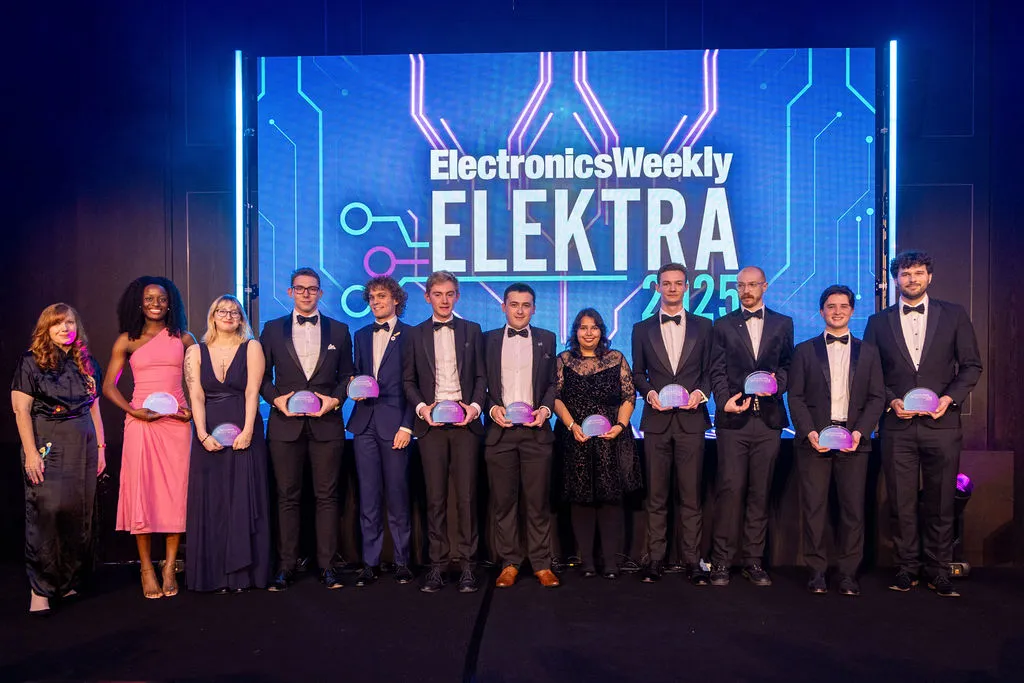
See also: Elektra Awards 2025 – The Winners