Posted on 30th March 2026 | Modified on 30th March 2026
Business, World Region - Asia
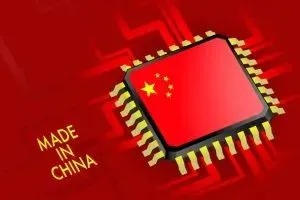
Thirteen executives in the Chinese chip industry, including Yangtze Memory Technologies chairman Chen Nanxiang and Naura chairman Zhao Jinrong, have drawn up a plan to achieve 80% self-sufficiency in semiconductors by 2030. China had around 33% self-sufficiency in 2024, so 80% by 2030 is ambitious. An earlier plan called ‘Made in China 2025’ aimed for 70% by 2025 but fell ...
Posted on 20th March 2026 | Modified on 20th March 2026
Business, World Region - Asia
Yesterday Japan’s Prime Minister Sanae Takaichi and Singapore’s Prime Minister Lawrence Wong (pictured) agreed to form a strategic partnership in trade, technology and defence. ‘We uphold the international order based on the rule of law, a rules-based multilateral trading system, and a free, open, transparent, resilient, inclusive and rules-based regional architecture’, said a joint statement. The two PMs asserted their ...
Posted on 18th March 2026 | Modified on 26th March 2026
News, World Region - Asia
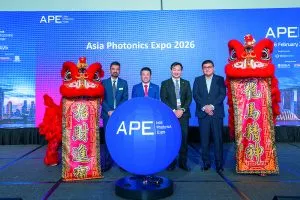
The importance of Singapore as a technology hub was reinforced at February’s Asia Photonics Expo 2026, reports Caroline Hayes. The three-day conference and exhibition hosted more than 350 exhibitors, from 17 countries and regions and 6,000 guests from 50 countries. “The convergence of photonics and semiconductors is becoming a defining shift for the industry, particularly as AI and high-performance computing ...
Posted on 10th March 2026 | Modified on 12th March 2026
Business, World Region - Asia
The Council for Japan’s Growth Strategy, chaired by Prime Minister Sanae Takaichi (pictured), has produced a plan to be implemented in the summer which includes a target of having $250bn in domestic chip output by 2040, reports the Nikkei. In 2020, sales of Japanese domestically produced semiconductors totalled $32bn. A previous government target was $100bn by 2030. The government has ...
Posted on 13th January 2026 | Modified on 13th January 2026
Military/Aerospace Electronics, News, World Region - Asia
China has submitted two filings to the International Telecommunication Union (ITU), each for 96,714 satellites. The CTC-1 filing is for a single notional Non-Geostationary Orbit (NGSO) system. The CTC-2 filing is still at the Advanced Publication Information stage. CTC-1 and CTC-2 are early-stage ITU regulatory filings but don’t authorise launches. Although filed as two separate NGSO networks, CTC-1 and CTC-2 ...
Posted on 5th January 2026 | Modified on 5th January 2026
AI, Business, World Region - Asia
Furiosa AI, the Korean AI chip startup, plans to start mass production of its first IC this month. Furiosa AI was founded in 2017 by June Paik (pictured) formerly of AMD and Samsung and named after the Imperator Furiosa – a character in the 2015 film Mad Max: Fury Road. Furiosa’s accelerators use an architecture it calls Tensor Contraction Processor ...
Posted on 5th January 2026 | Modified on 5th January 2026
AI, Business, World Region - Asia
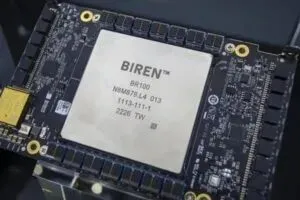
Another Chinese AI chip developer, Biren Technology, has had a stellar IPO. Biren shares rose closed 75% over the offer price on the Hong Kong stock exchange on Boxing Day, reports the Nikkei. Biren raised $716.85 million and achieved a market cap of $10 billion. Since Jan. 1, 2022, Biren has accumulated losses of $486 million. At of H1 2025, ...
Posted on 10th November 2025 | Modified on 10th November 2025
Distribution, World Region - Asia
DigiKey has officially launched an Indian subsidiary, DigiKey Electronics & Automation Trading Private Limited. It will be operating out of the distributor’s Global Capability Center (GCC) in Bengaluru (also known as Bangalore). The company is now employing 300 people in India. Indian subsidiary “This milestone represents a major step forward in DigiKey’s global strategy,” said Dave Doherty, its CEO. “India’s ...
Posted on 8th May 2025 | Modified on 8th May 2025
Business, World Region - Asia
The China solar panel industry which commands 80% of global solar panel production capacity, is taking a bath, reports the Nikkei. Nine of the top producers are Chinese and seven of those made a combined loss of $3.7 billion last year as investment outpaced demand. Five of the seven made a loss while market leader Jinko Solar saw profits fall ...
Posted on 24th March 2025 | Modified on 24th March 2025
Business, Manufacturing, World Region - Asia
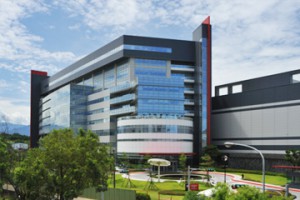
TSMC’s 2nm yields are now said to be well above the 60-70% reported by TF International Securities analyst Ming-Chi Kuo in December and headed for mass production this year. It is reported that TSMC could be producing 50,000 2nm wpm by the end of the year. TSMC’s 2nm fabs at Baoshan and Kaohsiung can run 80k wpm at full capacity ...