 There are a dozen electronics companies on the Canary Islands. The president of the special tax zone, Pablo Hernández González-Barreda, and his team have created a rising production hub for the film industry, including Amazon Studios, Netflix, Sony and Warner and a software cluster with success stories in AI, blockchain and software developed for Allianz, IKEA, Lufthansa and PwC.
Wafer metrology
Wooptix is a spin-off from Universidad de La Laguna, Tenerife. Just before the company celebrated its 10th anniversary it released an automated wafer shape metrology tool called Phemet, which measures 300mm silicon wafers with more than 16 million data points, several times more than current technology. Such ability enables rapid data analysis, which is essential for developing and designing wafers for sub-4nm technology. Wooptix has attracted big investors such as Intel, Samsung and Tokyo Electron.
CEO José Manuel Rodriguez Ramos studied physics at the Universidad de La Laguna and, in his fourth year, specialised in astrophysics.
He was one of six graduates funded to pursue a PhD in adaptive optics; specifically, how the changes in the refractive index caused by atmospheric turbulence blurred the image. Over the years his studies focused on correcting the blurring in real-time (10ms) using a deformable mirror.
“The world’s largest visible-light telescope was then under construction in the Canary Islands, a 10m diameter segmented surface,” he recalls. How to phase 36 mirrors with nanometric precision? “Looking at the sea on the north coast of Tenerife, imagining the water as the atmosphere, I imagined each wave breaking on the shore as reaching the telescope. Just as water dissolves in sand, and the sand acts as a telescope, the irregular surface of the telescope could be considered another wave, another ripple.”
The proprietary Wave Front Phase Imaging technology uses broadband light to illuminate a target and its surface reflects it. Any height variation causes a phase change. This is detected and analysed. The technology quickly acquires sub-nm resolution wavefront shape with a resolution of 4,700×4,700 pixels.
Wooptix will be closing Series D later this year.
Robotic telescope
Gerardo Morales-Hierro is co-founder of TTT. He studied industrial engineering, which, in Spain at the time, was a six-year degree with a broad, generalist approach that opened the door to many fields of technology.
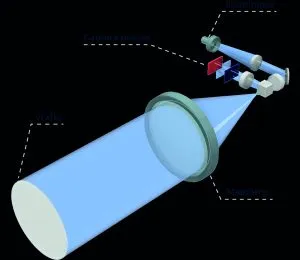
Overview of Wooptix’s Wave front sensor technology
“As soon as I finished my studies, I became involved in science and developed a particular interest in how scientific knowledge can be translated into systems or solutions that generate socioeconomic value, solve concrete problems and have a measurable impact on society. This perspective has guided my education and, later, my professional decisions,” he says.
He became a co-founder of Light Bridges, an initiative in public-private collaboration led by Dr Antonio Maudes. Light Bridges designs, develops and operates advanced scientific and technological infrastructure, particularly in astronomy, space technologies and data-intensive systems. It works across the full lifecycle, from concept and design to deployment, operation and scaling.
A flagship project is the Two-meter Twin Telescope (TTT) at the International Teide Observatory. TTT is currently the world’s largest fully robotic optical telescope. It is owned by Rictel TTT and has been financed entirely with private capital. As part of its role as a research facility, the TTT acts as an integration platform that brings together scientists, engineers, industrial partners and private capital, enabling the translation of frontier scientific capabilities into operational tools, services, and, where appropriate, new technology-driven ventures.
Articulating his vision for TTT, Morales-Hierro says: “In space and astronomy, new and bigger robotic telescopes are already being planned, and new scientific infrastructures are emerging for fields that are still incipient yet highly relevant and rapidly growing, such as optical communications between space and Earth, both classical and quantum, as well as space surveillance. This is not a distant future; it is something we are already doing, working with leading global operators in these technologies, where we provide the ground segment. Our ultimate goal is to demonstrate that scientific excellence does not need to remain confined to academia, and that EU regions with strong knowledge assets can generate globally relevant innovation if the right structures are in place.”
TTT continues to forge new collaborations between research centres and businesses, nurturing talent in astrophysics and continuously improving its technology.
Lidar technology
While studying at the University of Las Palmas, Gran Canaria, Tomás Herrera Azorin was fascinated by sensors and how light is converted into electricity. He started a technical services company, Estudio Itac, and later joined forces with José María Luque, who was running another engineering services company, Intosur, to combine their resources to form Aerolaser System in 2004.
Aerolaser provides in-house integration of sensor systems, geospatial services and customised solutions using lidar and the company’s own AI models.
Its lidar technology enables the control of electric grids, crop fields or any imaginable issue to be measured.
Chief technology officer Herrera Azorin explains that the company provides powerline analysis using drones, helicopters or aircraft. “Drones are fine for a few km, but they are problematic over restricted areas such as airports and militarised zones. In those cases, we use helicopters and aircraft,” he says.
Projects are varied and the company can adapt its technology and expertise for very difference environments. For example, the company sent two members of the team to Mexico with portable sensors to carry out targeted data capture in the field, adds Herrera Azorin.
Aerolaser is headquartered in Gran Canaria, with offices in Córdoba, Barcelona and São Paulo, Brazil, and has clients across Mexico, Europe and Africa.
Clearly, in addition to warm climes and holidaymakers, there is a passion, energy and determination to make the Canary Islands a place of high-tech innovation and industry.