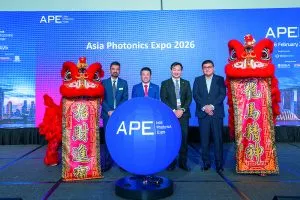
 The three-day conference and exhibition hosted more than 350 exhibitors, from 17 countries and regions and 6,000 guests from 50 countries.
“The convergence of photonics and semiconductors is becoming a defining shift for the industry, particularly as AI and high-performance computing place new demands on data movement, energy efficiency and system integration. As photonics moves from research into industrial deployment, the ability to build strong partnerships across technology, manufacturing and talent will be critical,” said Ang Wee Seng, executive director of Singapore Semiconductor Industry Association (SSIA)
“Photonics is where computing, connectivity and AI engage,” he said in a keynote, adding that Singapore has a local ecosystem with a global outreach.
Photonics for high performance computing and AI as well as telecom and datacom is not intended to replace, but to complement silicon, he continued, adding that a five-fold increase in photonics is expected in the next decade and that the market is projected to be worth $40bn by that time. Keys to this growth, he said, will be co-packaging of optics and the ecosystem challenge for integrated photonics.
Ang ended his keynote by revealing a secret to the audience: he delivered his keynote using a teleprompt in the glasses he was wearing.
SSIA role
Speaking to Electronics Weekly, Ang said that the SSIA plays an ecosystem orchestration role, connecting industry, government, academia and international partners to help companies scale and compete globally.
“We convene platforms such as the SSIA Summit, Semiconductor Business Connect, Electronics Industry Day and the Semiconductor Women’s Forum to enable knowledge sharing, partnerships and talent development. We work closely with agencies like EDB, ESG, MTI and WSG to shape industry programmes, including Career Conversion Programmes, leadership development and workforce transformation initiatives.
“We also support SMEs through business matching, innovation showcases and access to global markets, while strengthening regional collaboration through initiatives such as the ASEAN Semiconductor collaboration and strategic partnerships with countries like India, the Netherlands, Vietnam and Malaysia.”
The island state has positioned itself as the gateway to Asia and has a stable government that has been able to implement policies to growth policies. The ruling People’s Action Party, currently led by Lawrence Wong, has won 14 successive elections and has been in power since Singapore gained independence in 1965.
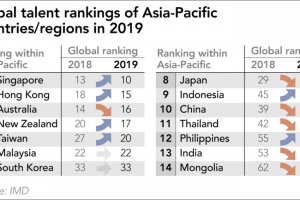
In its Economic Strategy Review the government named leveraging technology and innovation as one of its key areas for 2026, together with nurturing startups. There are more than 4,500 startup companies on the island, which is ranked #3 in the Global AI Index.
“Singapore’s startup vibrancy stems from its open economy, strong research base and access to global markets,” said Ang. “Government support through grants, test bedding and industry collaboration has lowered barriers to innovation. Proximity to manufacturing capabilities allows deep tech startups to prototype, validate and scale more effectively. The presence of multinational anchor firms creates opportunities for collaboration, talent mobility and customer access, while a growing venture ecosystem provides funding and mentorship. This combination makes Singapore an attractive launchpad for technology startups serving regional and global markets,” he said.
 Singapore’s digital economy is currently 17.7% of GDP and this year AI chip manufacturing is expected to boost the economy.
Singapore’s advantages
Ang told Electronics Weekly: “Singapore offers a combination of strong governance, policy stability and world class infrastructure, which creates a trusted environment for high tech investments. We have robust IP protection, a transparent regulatory framework and a business-friendly ecosystem that reduces risk for multinational companies and startups alike.
“Talent is a key differentiator, supported by close collaboration between industry and institutes of higher learning such as NUS, NTU, SIT, SP and ITE, ensuring a pipeline of skilled, AI ready and photonics ready engineers. Singapore’s diverse and globally connected ecosystem, with strengths in advanced manufacturing, precision engineering, materials and equipment, also enables companies to innovate, scale and integrate seamlessly into global supply chains.”
The SSIA facilitates collaboration between research institutes, startups and industry players to accelerate technology translation and supports pilot projects, industry attachments and joint development initiatives that “bring photonics innovations closer to real world applications”.
“Through international partnerships with Dutch, Taiwanese and other global photonics ecosystems, we help local companies access expertise, testbeds and market opportunities, strengthening Singapore’s position as a regional photonics hub,” said Ang.
He also identified key drivers, including the rise of AI, datacentres, high performance computing and advanced communications, all of which rely on photonics for faster, more energy efficient data transmission.
“In manufacturing, photonics is critical for precision sensing, inspection and automation,” he continued. “The automotive sector is adopting photonics for lidar, imaging and advanced driver assistance systems. In healthcare photonics enables medical imaging, diagnostics and sensing applications. Sustainability is also a driver, as photonics supports energy efficiency, renewable technologies and smart infrastructure.”
Partnerships are important. Ang described how they provide access to “new markets, advanced technologies and global customers, helping [Singapore SMEs] scale beyond domestic limits. They gain exposure to best practices, innovation processes and international standards, which strengthens their competitiveness. For international companies, collaborating with Singapore SMEs offers access to a highly capable supplier base, agility and localised innovation within a trusted ecosystem,” he said. He declared the partnerships “create win-win outcomes, fostering technology transfer, joint innovation and stronger, more resilient global supply chains”.
Fact file 1
A clear vision for augmented reality
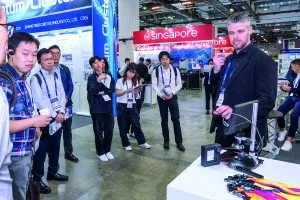
Among the highlights from the exhibitors were the smart glasses specifically designed for cyclists by Eversight, Elbit Systems’ augmented reality smartglasses spin-off.
They include optical components supplied by Singapore-based Opto Precision, including the prism and lens, which sit in the bridge of the lightweight glasses. The eyewear is angled from the bridge to place the lens directly in front of the cyclist’s eyeline as he/she leans over the crossbar to ride.
The partners are currently developing eye tracking and AI in the second generation of glasses, available by the end of this year. The second-generation glasses will be able to connect to AI phone apps and navigation devices, such as Garmin.
The glasses weigh less than 50g and use a proprietary, compact, free-space, off-axis optical system powered by an ultrabright colour micro-OLED image, which consumes less than 100mW. The display delivers a high contrast, wide field-of-view display and can be used for up to eight hours on a single charge. The lenses are designed to deliver >1,000 nits for clear images even in bright daylight conditions, said Eversight.
The glasses are available with prescription lenses.
Fact file 2
Micro LEDs replace interposer copper
Singapore’s NSC (New Silicon Corporation) exhibited its latest project. Using silicon nitride waveguides and micro LEDs to connect, for example, a GPU and high bandwidth memory, results in 32Tbps/mm operation, compared to ~1.5Tbps/mm using copper, explained Niu Jing, a scientist at NSC.
Replacing copper in semiconductor packaging with microLED optical links increases data rates and speed while resolving the issues of heat generation encountered by more traditional designs.
No fibre alignment or lasers are needed as the light is self-contained in the chip itself. Another advantage is that equivalent copper traces on existing interposers require greater power and therefore cause additional heating.
The research lab is working with commercial foundries such as Tower Semiconductor and the first tapeout is expected in the middle of this year.
NSC spun out from a research group within MIT’s research enterprise, the Singapore-MIT Alliance for Research and Technology, which conducted research into semiconductor and materials integration for the Low Energy Electronic Systems research group. It encourages collaboration for chip design for innovation in extended reality, mobility, smart lighting, telecommunications and wearables.