The aim is improved performance through faster data access. For example, UFS 5.0 enables sequential read and write speeds of up to 10.8GB/s. Note, however, the changes maintain compatibility with UFS 4.x hardware.
The UFS Host Controller Interface standard has also been updated to version 5.0.
“These advancements position UFS 5.0 as a foundational technology for next-generation devices, enabling higher performance, greater reliability and enhanced security for AI-enabled and other data-centric applications,” said Mian Quddus, chairman of the Jedec board of directors and the JC-64 Committee for Embedded Memory Storage and Removable Memory Cards.
Universal Flash Storage 5.0
As well as the read and write speeds of up to 108GB/s, the standards organisation highlights enhanced signal integrity through integrated link equalisation. This, it says, is to ensure reliable operation at higher data rates.
There’s also improved power integrity with dedicated supply rails. Version 5.0 introduces a distinct power supply rail to provide noise isolation between PHY and memory subsystem.
Finally, there are data protection advances with inline hashing. By performing data integrity checks directly within the storage path, says Jedec, UFS 5.0 enables faster and more efficient detection of data corruption or tampering.
Industry viewpoint
Commenting on the announcement, Jay Hyun, vice-president of the NAND Planning & Strategy Group at Samsung, said: “As edge device AI applications continue to increase, storage performance and efficiency have become increasingly important. UFS 5.0 meets these demands by delivering up to two-times the performance of UFS 4.1, while enabling smaller package designs and improved signal and power integrity.
“Faster booting support and more efficient SLC (single-level cell) buffer management further support responsive, sustained on-device AI processing across mobile, automotive and edge computing applications.”
You can read more about the new standards, JESD220H and JESD223G, on the Jedec website.
Note, we reported last week that Kioxia was already sampling UFS 5.0 NAND.
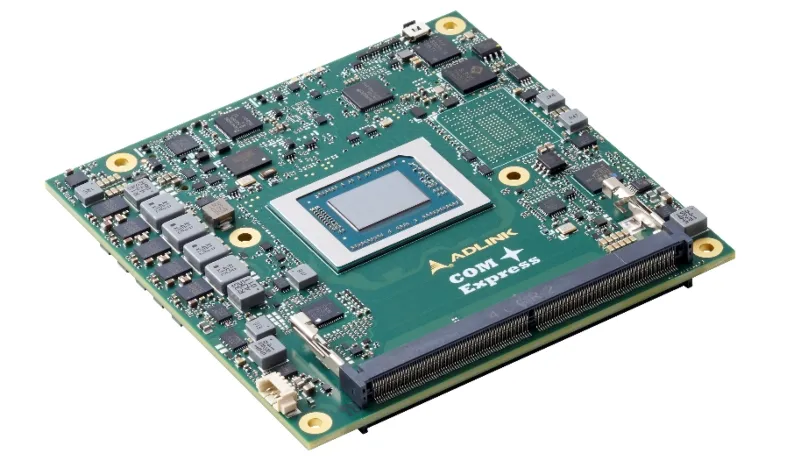
Image: A high-performance COM Express R3.1 Type 6 module from ADLINK for edge AI computing, the cExpress-R8