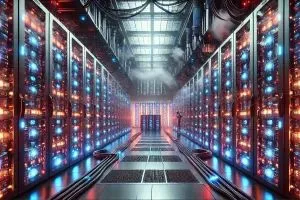
While demand signals remain exceptionally strong, power scarcity has become an increasingly binding constraint on near-term expansion, with on-site generation evolving from a contingency option to a practical necessity for large AI campuses.
“The DCPI market is undergoing a period of profound structural transformation,” said Dell’Oro’s Alex Cordovil. “Technology disruption is cascading across the stack as rising chip thermal design power and the approach of the one-Megawatt rack force fundamental changes in facility design. Despite power constraints, operators are deploying creative mitigation strategies to bring capacity online, supporting our decision to revise the DCPI growth outlook upward for the 2025-29 period.”
Thermal management is projected to grow at a 20 % CAGR and reach the value of the UPS market by the end of the decade, underscoring cooling’s evolution from a supporting function into a primary determinant of datacentre design.
Direct liquid cooling is forecast to surge, surpassing $8bn by 2030, as it transitions from an enabling option to a foundational technology for AI factories; Nvidia’s latest Vera Rubin compute tray designs eliminate fans entirely, enabling fully liquid-cooled configurations.
Cabinet PDU & Busway will expand as overhead busway systems become the default architecture for slab-based AI factories; emerging DC power distribution architectures are expected to influence deployment choices toward the end of the decade.
Service providers — including cloud, colocation and neocloud operators — are forecast to grow DCPI spending at roughly five-times faster than enterprise, reflecting the increasing complexity and capital intensity of AI-ready infrastructure.
Power availability has become a binding constraint, with grid interconnection delays and transmission bottlenecks driving surging demand for natural gas turbines and reciprocating engines as operators deploy on-site generation to bring multi-hundred-Megawatt and Gigawatt-scale campuses online.