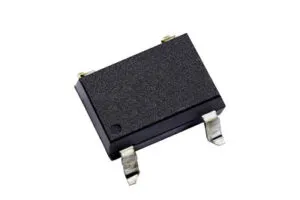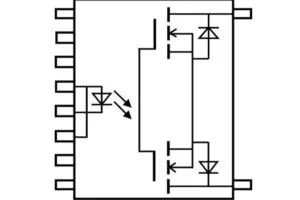

With G3VM-401xY2 and G3VM-601xY2 base numbers, the 400V (120mAdc, or peak ac, continuous) and 600V (90mA) devices have typical on-resistances of 22 and 45Ω respectively with 5mA though the input led. Max figures are 35 and 60Ω, and resistances are a little lower for the first 1s of operation, according to the data sheet.
The devices will trigger with ≥2mA and turn off at ≤0.1mA – diode drop is typically 1.27V at 10mA. Max switch leakage is 1μA when ‘off’.
Operation is over -40 to +110°C, and ac isolation rating of 5kVrms for 1min.
Package body is 4.6 x 6.4 x 3.6mm, and (see photo) there are through-hole (x=A in the part number) and surface-mount (x=D) variants.
Applications are foreseen in electricity meters and industrial control. “Operating temperatures can be a particular challenge for designers of electricity meters as these units have to be sealed to prevent tampering,” said the company.
The miniature 40V part, G3VM-41UR4, has a 10pF·Ω figure-of-merit with Coff=5pF (7pF max) and Ron=2Ω (3Ω max, both 5mA in). Replace the ‘4’ at the end (see the data sheet for options) to get other FoMs, between 4.5 and 4.9pF·Ω, and there is a related 50V part.
Max leakage through the output switch is 1nA (30V 50°C).
It can handle up to 250mA at 40V (both figures are dc, or peak ac) – although current has to be reduced by 2.5mA/°C above 25°C. For pulsed operation (100ms 10% duty), current can be increased to 750mA.
Turn on and turn off are 80μs and 40μs respectively (both 300μs max).
Operation is again over ambients of −40 to +110°C.
Applications are foreseen switching test signals in test and measurement – particularly ATE systems, and in communications equipment.
G3VM-401xY2 and G3VM-601xY2 can be found on this data sheet
G3VM-41UR4 can be found in this data sheet