The polyner’s flexibility and suitability for large-area mounting should bolster vibration detection and monitoring technologies across mobility, robotics, industrial machinery, aerospace, and other fields.
Piezoelectric materials generate voltage in response to stress, vibration, and other external sources.
Applications include microphones and strain sensors
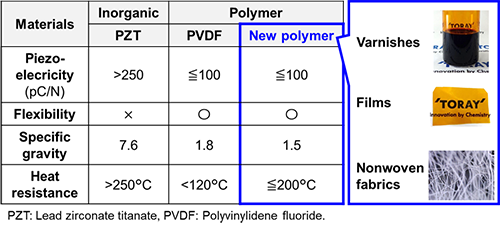
The two prime piezoelectric materials have some drawbacks. The first is polyvinylidene fluoride. It loses its polarization structure at 120°C, so its maximum operating temperature is about 80°C.
The second is lead zirconate titanate. While highly piezoelectric, it is hard and brittle, so it is hard to mount on complex shapes or large areas.
Recent years have seen demand for vibration detection and monitoring sensors extend across such fields as mobility, robotics, industrial machinery, and aerospace. Automakers are exploring active noise cancellation (note 3) to suppress road noise.
Robotics producers are considering vibration detection for haptic feedback. Industrial machinery and aerospace manufacturers are looking into vibration monitoring to continuously survey vibration and detect early anomalies.
These fields require sensors mounted over large areas to accurately capture vibrations across extensive regions.
Applications near motors and engines, in space environments, and on heat transfer piping require piezoelectric materials to perform at above 100°C in hot ambient environments.
Toray innovated its piezoelectric polymer by drawing on its polymer molecular design and higher-order structural control technology.
The material upholds its polarization structure even above 200°C, ensuring stable detection in hot environments where using polyvinylidene fluoride is impossible.
This polymer is available as a varnish, film, or nonwoven fabric, for use with sensors with complex shapes or large areas.
Another benefit of this material is that it is free of lead or fluorine and complies with the Restriction of Hazardous Substances directive (note 6) and per- and polyfluoroalkyl (note 7) substance regulations.
Toray targets practical applications for this polymer from around 2028, and is providing and assessing customer samples to cultivate and broaden its applications.
Comparisons of conventional piezoelectric materials and Toray’s new polymer
Piezoelectric environmental stability of polyvinylidene fluoride and new polymer