The round was led by Supernova Invest and 360 Capital, with participation from BNP Paribas Développement, Crédit Agricole Alpes Développement and CEA Investissement.
Founded in February 2025, iNGage is headquartered in Grenoble and has a design team in Milan.
Its locations reflect the source of its technology: over 15 years of joint research between French semiconductor lab CEA-Leti and Italian university Politecnico di Milano.
“We believe iNGage’s MEMS technology will be ubiquitous across mobility, industry and defense,” said BNP Paribas’ venture capital director Nicolas Tymen. “We are proud to join this first round of a cross-border project with global potential.”
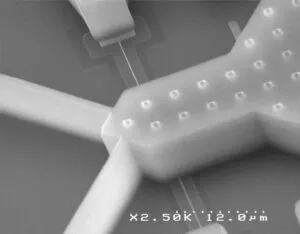
iNGage’s key intellectual property is in etched nano-wire piezo-resistive strain-gauges – it has over 30 patents covering this and associated technologies.
From this, the company claims that it can design inertial sensor ICs that will sit between low-cost commercial MEMS accelerometers and gyros, and larger high-cost fibre-optic devices – it has revealed 0.05°/h bias instability and 0.006°/√h angular random walk from prototypes.
It also claims that its “technology will enable positioning accuracy of ~50cm after several minutes of high-speed driving without GPS”.
“Consumer-grade drift too quickly: a few meters errors in a few seconds,” chief business officer Vincent Gaff told Electronics Weekly. “Our components can only be compared to professional modules like the ones provided by Honeywell, Silicon Sensing Systems, SBG, and InertialLabs.”
He provided the following preliminary specification for the forthcoming product:
- Size: 9 x 9 x 3mm
- Weight: 2g
- Power: 100-200mW
- Gyro bias instability: 0.1°/h
- Gyro angular random walk: 0.01°/√h
- Gyro bias over temp: 10 to 30°C/h target
- Accelerometer bias instability: 10µG (where G is gravity)
- Accelerometer bias over temperature: 3mG/°C
“We are at the state-of-the-art on gyros, which is the most challenging,” said Gaff. “We are similar [to others] on accelerometers, but having the six-axes on a single sensor with our performances will be really exceptional.”
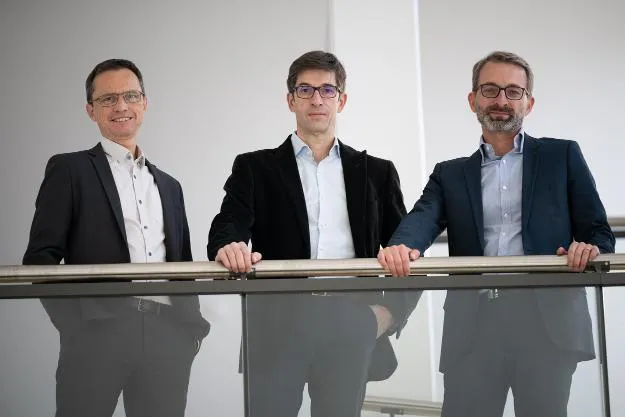
The company was incubated at CEA-Leti and is backed by a founding team including CEO Philippe Robert (left in photo, formerly of CEA-Leti), COO Bertrand Gautheron (centre, formerly Aryballe Technologies and STMicroelectronics) and chief business officer Vincent Gaff (right, formerly of TDK’s Tronics Microsystems).
The funding will be used to finish the design of a three-axis gyroscope, and a single-chip six degrees of freedom inertial sensor measuring acceleration and angular velocity in all directions.
“The first-round investment also will support technology transfer to a commercial MEMS foundry for sampling and production across defence, industrial and automotive markets,” it added.