
In the other one, a pair of Teledyne CIS120 sensors launched on GOSAT-GW, Japan’s global observing satellite for greenhouse gases and water cycle satellite
Sentinel-4 will be spread across multiple satellites, with this Sentinel-4 package hitching a ride on one of Meteosat third-generation sounder satellites (MTG-S).
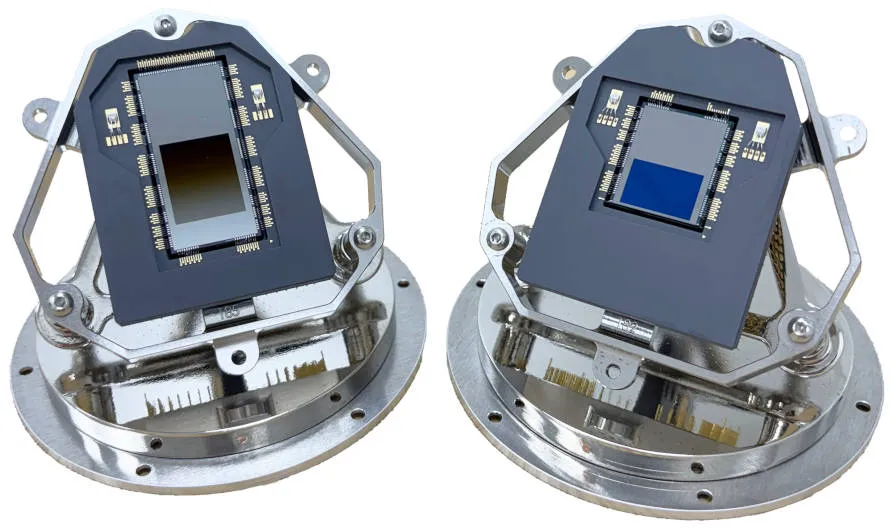
Designed to scan the earth for 10 years, this part of Sentinel-4 is carrying two Teledyne CCD sensors within its ultra-violet to near-infra-red imaging spectrometer (see photo) :
CCD374 covers UV to visible wavelengths, using a graded anti-reflection coating which means each row is optimised for a different wavelength between 305nm and 500nm.
It has an array of 600 x 1,290 pixels, each 27.5 x 15μm, and split frame transfer operation with 260 rows transferring upwards and 1,030 rows transferring downwards. “Split frame transfer means the detector is read through four outputs to increase speed,” the company told Electronics Weekly.
CCD376 has a lsimple standard coating and is optimised for 750-775nm near-IR.
It has a 600 x 713 pixel array, also of 27.5 x 15μm, and frame-based data transfer.
“Spectra scanning is done by external optics, said Teledyne. “For the CCD374, a beam splitter is used so that wavelengths of interest are aligned with the optimised row of the device. Different pollutants or compounds like CO2 will show wavelength signatures.”
The sensors are designed to last for at least 10 years in space.
From a geostationary orbit, the aim is to image the earth at many wavelengths, from which information on trace gases including ozone, nitrogen dioxide and sulphur dioxide can be extracted. Data on the troposphere over Europe will be sent to air quality monitoring projects on the ground every hour.
“Our sensors were selected due to the heritage of our work on Sentinel-2 and -3, as well as internal developments that met the needs of this mission,” said Teledyne lead engineer Ross Mackie.
The CCDs were manufactured, packaged and tested in Chelmsford UK.