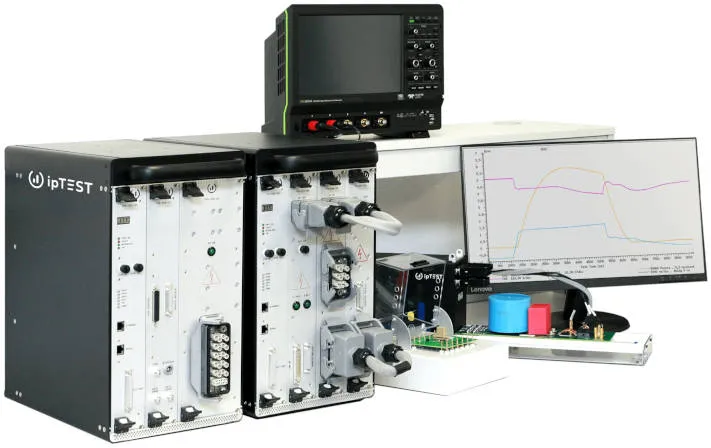
- Quasar200 is for dc and ac evaluations of silicon, galium nitride and silicon carbide devices.
- Pulsar600 is a higher current version – for shorts up to 10kAac – particularly suited to testing SiC inverters and automotive systems, according to the company.
“Both platforms offer up to ±0.1% measurement accuracy across all voltage and current waveforms, with typical parasitic inductance below 30nH in ac tests, it said, claiming: “UKAS-traceable calibration and comprehensive audit logs ensure reliability, consistency and compliance from lab benches to production lines.”
±0.1% is the accuracy for dc testing, while ac current and voltage are measured to 2%.
Probe bandwidth is 400MHz in the 200, dropping to 120Mhz in the 600 version.
In the higher current Pulsar600, up to 1.4kV and 3kA can be switched during ac testing, and dc testing is at up to 3kA with two current ranges: 100nA to 100mA, and for lower voltages 100nA to 600A.
For safety, the device-under-test is un-touchable during testing. “A fully enclosed test environment with interlocked access to protect both operators and hardware – crucial during high-stress or destructive testing,” according to the company ipTest. “This safeguards investments and ensures peace of mind when pushing devices to their performance limits.”
Based in Surrey UK, ipTest is a subsidiary of Italian company Microtest.
Find the testers on this Microtest web page