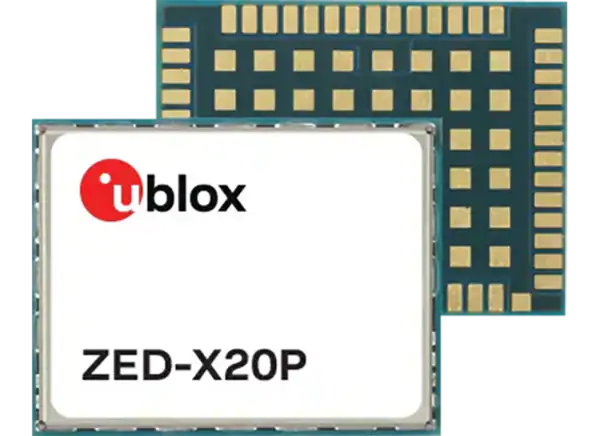
Basically, the module integrates all-band GNSS with signal modernisation and positioning algorithms. Signals processed comprise: GPS, Galileo, BeiDou, QZSS, and NavIC.
Possible use-cases include for UAVs, guidance systems, auto-steering and high precision positioning, for example within industrial and agricultural applications.
In terms of serial interfaces, there are two UART, one SPI and one DDC (I2C compliant) connections. For digital I/O, there is EXTINT input for wakeup, RTK fix status (Real-Time Kinematic is a high-precision GNSS positioning mode) and GEOFENCE status.
There is also a 0.25Hz to 10MHz configurable time pulse range, and support for NMEA, UBX binary, RTCM v. 3.4, and SPARTN v. 2.0.2 protocols
Note that it natively supports a range of correction services. For example, it supports standard RTCM corrections for Virtual Reference Stations (VRS) in a Network RTK or a local base station setup. SPARTN-format SSR correction service broadcasts are also supported for mass-market applications, and direct reception of PPP global services simplifies deployments.
Mouser writes:
“With a very high update rate, the ZED-X20P module is ideal for control applications, ensuring smooth and reliable operation. For advanced users, pristine raw data features minimal cycle slips and exceptionally low noise in carrier range and pseudo-range measurements. ZED-X20P protects system integrity with multi-layered defenses, including a Root of Trust, jamming/spoofing detection, cryptographic authentication of navigation messages through Galileo OSNMA, and more. High-value, application-specific features such as a moving baseline are also available.”
Features
It is built on the u-blox X20 GNSS platform and features a TCXO oscillator, a built-in RTC crystal, CW (CW) detection anti-jamming support, and anti-spoofing algorithms.
More details of the specification are below:
-
- Receiver type
- 672-channel u-blox X20 engine
- GPS L1C/A, L2C, L5
- GAL E1B/C, E5a, E6
- BDS B1I, B1C, B2a, B3I
- QZSS L1C/A, L1C/B, L2C, L5, L6
- NavIC L1, L5
- SBAS L1C/A
- Up to 25Hz RTK navigation update rate
- Position accuracy
- 0.01m + 1 ppm CEP for RTK
- 0.10m CEP for PPP
- Convergence time
- <10s for RTK
- <120s for PPP
- Acquisition
- 27s cold start
- 2s aided start
- 2s reacquisition
- Sensitivity
- -167dBm tracking and navigation
- -148dBm cold start
- -157dBm hot start
- -16odBm reacquisition
- Receiver type
You can read more details and the full specification on the Mouser website.
Note that the distributor also stocks the u-blox EVK-X20P kit for evaluating the ZED-X20P.
“This sophisticated tool is designed with a user-friendly interface and comprehensive documentation to facilitate easy integration and testing, allowing developers to quickly harness the high precision capabilities of the ZED-X20P for innovative geolocation services and drone operations,” writes Mouser.
Image: Mouser
See also: Advent talking about buying U-Blox