“We’re proud to extend the lifetime of this COM standard,” according to Tria product manager Markus Mahl. “Developers can boost system performance without changing their existing Q7 designs. As a result, their systems can support updates, compliance changes, and evolving needs without requiring a complete redesign.”
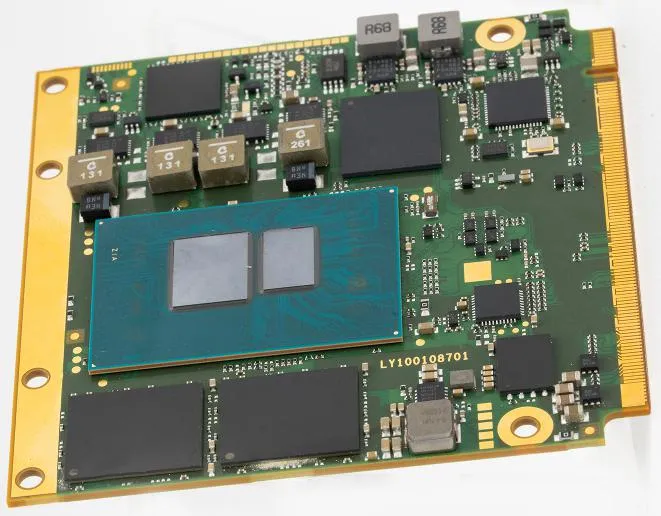
Each can support three independent 4K displays, and support up to 32Gbyte of LPDDR5 memory.
The modules are:
- Q7-ASL, with Atom x7000RE/C (Amston Lake) processors
- Q7-ALN, with Atom x7000E, Core i3, or N Series (Alder Lake-N) processors
Both module types have dual, quad and eight-core options, and Intel Xe architecture UHD graphics.
Interfaces include USB 3.1, PCIe Gen3, eMMC 5.1 and 2.5Gbit/s Ethernet (via Intel i226) and support up to 2.5GbE bandwidth.
With sufficient heat removal, operation is over 0 to +60°C, with Q7-ASL types extending this to -40 to +85°C.
Windows 10 LTSC, Windows 11 LTSC and Yocto Project (LTS kernel 2021) are supported.
Use is expected in point-of-sales terminals, digital signage, medical equipment, transportation, IoT and industrial automation.
Find the boards on these Tria web pages: Q7-ASL and Q7-ALN.
Tria Technologies was formerly MSC Technologies, which became Avnet Embedded and then Tria. It has design and manufacturing in Europe, North America and Asia.