The American company specialises in space domain awareness and uses AI for its space modelling and simulation.
Sensor networks
Basically, its sensor networks will improve the agency’s ability to track and characterize satellites and orbital debris.
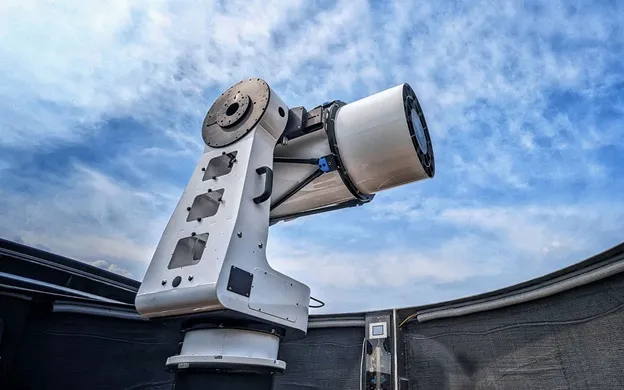
Specifically, under the contract Slingshot will deploy 13 new optical sensor systems across five global sites. This will enable high-precision tracking and monitoring for satellites. But also for space debris and other near-Earth objects, for example asteroids and comets.
Note that Slingshot will partner with Baader Planetarium, the manufacturer of astronomical equipment. This will be to provide each site with AllSky Domes for autonomous, 24/7 operations.
AI
 “Our partnership with the UK Space Agency establishes a strong foundation for the United Kingdom to expand mission-critical space capabilities—not only in hardware, but also in advanced data services, AI-driven insights and real-time mission support,” said Tim Solms, CEO of Slingshot Aerospace, right.
“By joining this global network, the UK is showing how accessible space safety and sustainability can be and setting an example for other nations looking to build and strengthen their own space programs.”
Slingshot Aerospace is based in El Segundo, California. It also has international offices in Ottawa and at Spaceport Cornwall.
Slingshot
“We are delighted to welcome Slingshot onboard as our delivery partner for a global network of optical space sensors,” said Angus Stewart, Head of the UK’s National Space Operations Centre.
“This sensor network is critical to our mission of protecting UK and allied interests in space and on Earth, and ensuring space remains safe and sustainable.”
Slingshot provides the context that 12,000 satellites are currently in orbit today. With circa 100,000 expected by 2030.
Images: Slingshot Aerospace
See also: UKSA funds 23 projects for international space partnerships