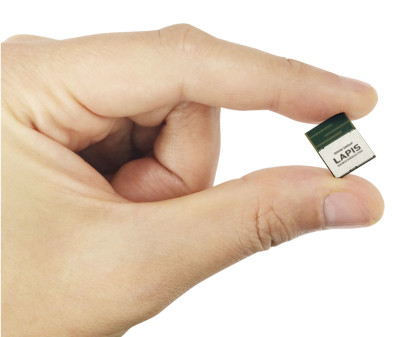
The latest Bluetooth module of Lapis Semi
Called MK71050-03, it uses Lapis’ MK7105 silicon whose tranciever achieves <9mA transmit and receive.
“The internal pattern antenna optimised for the ML7105 was developed in collaboration with Insight SiP,” said Lapis. “The EEPROM, crystal oscillator, and antenna matching circuit required are included and all required performance optimisations are performed at Lapis Semiconductor’s facility.”
The 11x14mm module needs no adjustment and is aimed at companies without wireless expertise that want to add Bluetooth. It is pre-certifiedin Japan, North America and Europe.
There is a USB evaluation kit for development, available from RS Components, Chip One Stop, and Core Staff.
“The necessary documents and sample software can be downloaded online. Also, a smartphone app compatible with the USB evaluation kit is available free of charge that makes it possible to test Bluetooth Smart communication using a smartphone,” said Lapis.
 Applications in health and fitness devices are expected. Enabled profiles include: HRP (heart rate), HTP (health thermometer), BLP (blood pressure), GLP (glucose), BAS (battery service) and DIS (device information).
| Parameter | Specifications |
|---|---|
| Features | Bluetooth SIG Core Spec v4.0 compliant |
| Low power consumption wireless communication module | |
| SiP (System in Package) design | |
| Bluetooth certified | |
| Wireless certification acquired for various countries – Radio Law (Japan) – FCC 15.212 modular certification (US) – EN300 328 (Europe) |
|
| EEPROM built in for storing user data (16kbyte max.) | |
| UART I/F for Bluetooth Host Controller | |
| SPI (Slave) I/F for Custom Host Controller | |
| Supports low power clocks (32.768kHz) for intermittent operation | |
| Built-in regulator | |
| Supply Voltage | 1.6 to 3.6V, 3.3V typ. |
| Consumption | 0.7uA (Sleep Mode) 9mA typ. (Transmission) 9mA typ. (Reception) |
| Package | 52pin LGA (10.7mm × 13.6mm × 1.78mm) |