
It won it for its Digital Displacement digitally-controlled hydraulic power system for off-shore wind turbines. “The smart modular system has been designed to overcome the significant reliability issues associated with existing turbines,” said the Academy.
“The Artemis system is a massive leap forward for hydraulically powered systems,” said judge Dr Gordon Masterton OBE FREng FRSE. “The team has done for hydraulic engines what James Watt did for steam engines; they have totally transformed the efficiency and range of potential applications. The largest floating wind turbine in the world is to be powered with a Digital Displacement transmission.”
The Duke of Edinburgh presented the prize to Artemis Intelligent Power MD Dr Niall Caldwell, operations director Pierre Joly, chairman Dr Win Rampen FREng, non-executive director Professor Stephen Salter FRSE and chief engineer Dr Uwe Stein. The Duke is the Academy’s Senior Fellow.
The winners receive a gold medal and a £50,000 prize.
Other finalists were:
Cambridge-based Endomag with a breast cancer diagnostic tool that avoids the use of radioactive tracers in determining the spread of cancer through the lymphatic system.
Blackpool-based Victrex, for the development of polymers in ultra-thin sheets for use in smartphone and tablet speakers.
Artemis was spun out of the University of Edinburgh in 1994.
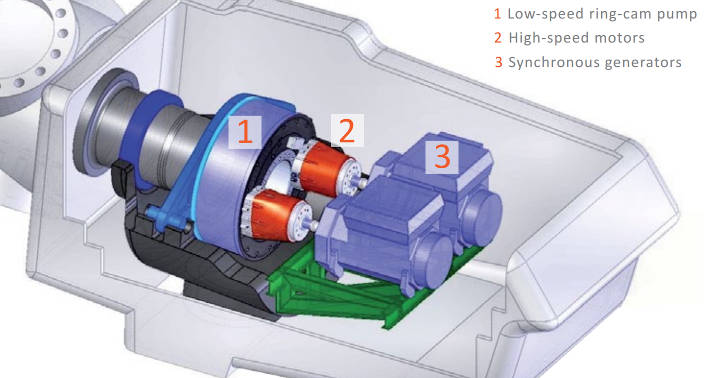 Digital Displacement
Digital Displacement is a hydraulic power transfer system with mechanical valve control replaced with computer-driven valve commutation. It is “analogous to the introduction of common-rail direct fuel-injection in vehicles”, according to Artemis. Most of the refinements for performance are within easily swapped valves, electronics and software instead of within complex mechanisms.”
This also means limitations in component positions are reduced and, according to Artemis, noise reductions because oil-compressibility energy is naturally recovered.
Pumps and motors are inherently variable-displacement – each pump cylinder has an active low-pressure valve and a simple non-return high-pressure valve. In motors the high-pressure valves are also active.
When power is needed, pump and motor cylinders are enabled just-in-time at bottom or top-dead-centre if their contribution is required, otherwise they idle – breathing oil in and out at low-pressure and placing little parasitic burden on the active cylinders.
Artemis is applying the same technology to reduce the fuel consumption of commuter trains and buses. “A regenerative braking energy storage system based on Digital Displacement can be retrofitted to existing diesel commuter trains,” said the Academy. Trials with Ricardo and Bombardier have shown 10% less fuel consumption, less noise and lower exhaust emissions in stations.
With Lothian Buses and Alexander Dennis, Artemis said it has demonstrated fuel savings of up to 27% on urban buses, claiming a two to three year payback for bus operators without subsidies.
