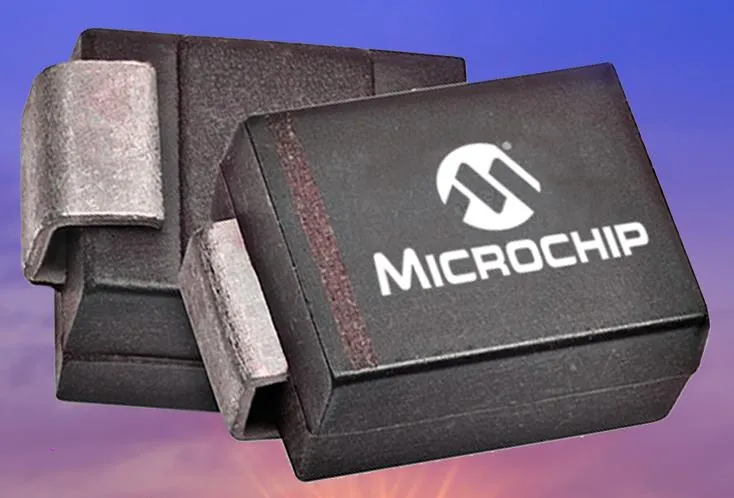
“These TVS devices are the first in the industry to achieve MIL-PRF-19500 qualification in a plastic package,” claimed the company.
Voltage ratings range from 5V to 175V, and Microchip lists several variants:
- JANPTX1N5555UJ
- JANPTX1N5558UG
- JANPTX1N5629AUJ
- JANPTX1N5665AUG
- JANPTX1N5907UG
- JANPTX1N5907UJ

There are a total of 84 variants. Microchip told Electronics Weekly: “There are three sets –
- 1N555 through 1N5558 = four parts (each is part number is sequential i.e. 1N5555, 1N5556, 1N5557, 1N5558)
- 1N5629A through 1N5665A = 37 parts (same logic as above, 1N5629A, 1N5630A, …)
- 1N5907 = one part
This is a total of 42 parts with two package options for each one UJ and UG (UJ = J-lead, UG = gull wing).
Parts with a G suffix are in gull-wing DO-215AB (SMCG) packaging
Parts with a J suffix are in J-lead DO-214AB (SMCJ) packaging
Beyond this, Electronics Weekly has asked what differentiates the variants. The company responded: “The stand-off voltage is different for each 1Nxxxx number and then the lead bend finish. The TVS require a large family of parts to support various voltage levels.”
Pulse rating is up to 1.5 kW (10/1,000µs)and clamping can be in as short as 100ps.
“The devices help safeguard airborne avionics, electrical systems and other mission-critical applications,” according to the company. “Their design supports protection from switching transients, induced RF effects, EMP [electromagnetic pulse] and secondary lightning events, designed to meet IEC61000-4-2, IEC61000-4-4, and IEC61000-4-5 standards.
Spice models are available for development.
Find the data sheet on this Microchip web page