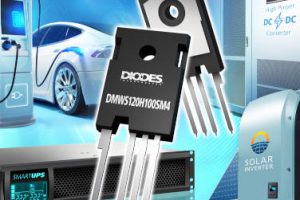

“With BVceo up to 100V, continuous current to 10A – and 20A peak – and saturation voltage as low as 17mV, these transistors minimise conduction losses,” according to the company.
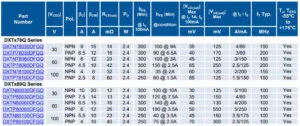
There are 12 devices, all in 3.3 x 3.3mm surface-mount packages with a 4.2°C/W thermal pad underneath and side-wettable flanks, split across DXTN78…Q, DXTN80…Q, DXTP78…Q and DXTP80…Q part numbers (see table).
Power ratings are ~1.6W on 15 x 15mm of 2oz copper and ~2.4W on 25 x 25mm 2oz copper.
Voltage ratings are 30V, 60V or 100V to cover 12V, 24V or 48V systems in “applications including mosfet and IGBT gate driving, load switching, LDO regulation, motor control and actuator control”, according to Diodes.
Operation is up to +175°C, and they are ESD rated to 4kV HBM and 1kV CDM.
That 17mV saturation is the typical value (30mV max) for the 30V 9A npn DXTN78030DFGQ, achieved with 1A collector current and 100mA base drive in a 25°C ambient.
At 10A Ic and 500mA Ib, the figures are 120mV typical and 160mV max.
Remove the Q at the end for equivalent parts suited to industrial and commercial applications.
The DXTN78030DFGQ data sheet can be found on this Diodes web page
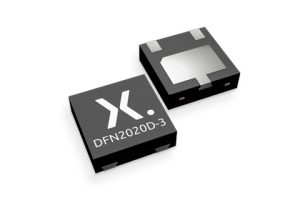
New bipolar transistors are not common, but they do occur – Nexperia, for example, released some up to 3A or 80V types in 2 x 2mm DFN packaging over a year ago