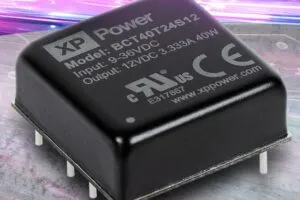

This converter measures ~34 x 37 x 20mm tall and can deliver up to 80A at 3.3 to 18V so long as the power limit is not passed.
The input is nominally 24Vdc, and can range across 18 – 32V.
There is also a wider range input version that can accept 18 – 60V.
Called i7A4W060A033V, it can 3.3 to 28V, but limited to the lower values of 60A and 720W.
Each comes in three versions: one with positive remote on-off signal logic and two with negative remote on-off signal logic, with an adjustable output current limit added to one of the negative versions.
The wide input and output voltage ranges “helps reduce the number of unique part numbers in the bill of materials, simplifying inventory management”, said the company. “An adjustable output current limit reduces overcurrent and short-circuit levels, lowering device stress during overload conditions such as charging large capacitive loads. This feature also enables parallel operation of multiple i7A modules.”
Efficiencies peak at 98 and 99% respectively.
These higher-power i7 variants have an enhanced baseplate which doubles up on input and output pins, and pushed weight up to 85g.
Operation is nominally over -40 to +115°C, and full power can be achieved with the baseplate at >90°C, but these are strongly affected by derating with respect to air flow and input-output voltage combinations – see the TDK specification for derating curves.
Standard PCB pin length is 3.68mm, with options of 2.79mm or 4.57mm.
There is another similarly-sized high-power i7 dc-dc module, this time limited to 550W and 100A, with 9 – 18Vin, 0.8 – 8Vout and 96% peak efficiency.
All models are certified to IEC/UL/CSA/EN 62368-1 and carry the CE and UKCA marks for Electrical Safety and RoHS directives.
| Type | i7A4W060A033V | I7A24080A033V |
| Input voltage | 18 – 60V | 18 – 32V (24V optimised) |
| Output voltage | 3.3 – 28V | 3.3 – 18V |
| Output power | 750W | 1000W |
| Efficiency | Up to 99% | Up to 98% |
| Size | 34 x 36.8 x 19.8mm | |
| Safety | IEC/UL/CSA/EN 62368-1, CE, UKCA Mark | |
Applications are expected in medical, communications, industrial, test, measurement, robotics and drones equipment.
As well as the specification, there is a 7i data sheet – both need to be read together. There are lower power i7 dc-dc converters