Design Software
Design software is a core pillar in electronics development, enabling precise PCB layouts, advanced simulation, and seamless product validation. From cloud-based platforms to AI-powered EDA tools, design software innovations continue to streamline workflows for engineers and accelerate time to market. Major players are expanding capabilities to support IoT, 5G, and automotive applications. Design software also integrates with component libraries, boosting accuracy and collaboration across global teams. Electronics Weekly tracks essential updates, product launches, and market trends in design tools, helping readers stay competitive and informed in a rapidly evolving electronics landscape. Stay tuned for the latest design software news here.
Posted on 16th March 2026 | Modified on 17th March 2026
Automotive Electronics, EDA and IP, Embedded Systems, Industrial Electronics, News, Products, Software
Axivion for CUDA has been announced by Qt Group as part of Nvidia’s Halos AI Systems Inspection Lab for automated safety checking of robots and autonomous vehicles. It provides continuous GPU/CPU code analysis measured against Nvidia guidelines and industry standards and generates the documentation needed by Halos for sign-off. It also enables the early detection of problematic issues to reduce ...
Posted on 21st July 2025 | Modified on 21st July 2025
Automotive Electronics, Design, Software
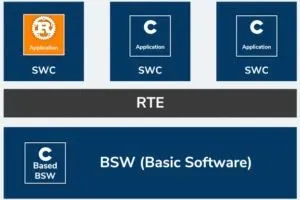
Rust applications can be Autosar software components on TC4x automotive microcontrollers, allowing Rust to run alongside C and C++, following a cooperation between HighTec EDV-Systeme, Elektrobit and Infineon. The three companies have created a development software bundle called ‘Drive Core Autosar (Rust)’, which includes: A version of Elektrobit’s Tresos Studio, including Tresos AutoCore Autosar-compliant basic software for automotive ECUs (control ...
Posted on 25th June 2025 | Modified on 25th June 2025
Design, EDA and IP, Embedded Systems, News, Products, Software
Designers looking to optimise PPA (power, performance, area) are finding that optimisation engines can render original programmatic timing constraints unusable in their original form. At DAC 2025, Ausdia introduced Timevision OneSource which automatically generates a new version of block-level constraints after optimisation engines have worked on hierarchies, duplicate elements and performed advanced transformation. Such optimisations can save two weeks of ...
Posted on 25th June 2025 | Modified on 26th June 2025
AI, Design, EDA and IP, Embedded Systems, News, Products, Software
San Francisco: At last year’s DAC, Baya Systems emerged from stealth mode. At this year’s event, the design software company announced a switch fabric technology that is claimed to enable a x100 increase in node density. NeuraScale is designed to overcome critical scaling and data movement challenges in AI infrastructure that are driving advanced SoCs and emerging 3D chiplet-based designs, ...
Posted on 24th June 2025 | Modified on 26th June 2025
AI, EDA and IP, News, Products, Software
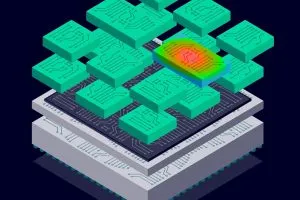
Two software tools, Innovator3D IC and Calibre 3DStress, address chiplet integration and thermal management at the transistor level. Siemens Digital Industries Software announced the duo at DAC 2025. The Innovator3D IC suite advances 3D IC integration using AI to execute chip design and raise productivity, as designers increasingly reintegrate chiplets into high performance substrates, said the company. It enables IC ...
Posted on 12th March 2025 | Modified on 25th June 2025
Automotive Electronics, Design, EDA and IP, Embedded Systems, News, Products, Software
Embedded World 2025: Synopsys says its Virtualizer Native Execution prototyping tool will accelerate software development for edge devices. It extends the Virtualizer tool suite and model libraries to Arm hardware, allowing virtual prototypes to be built, executed and tested directly on Arm-based machines. The Native Element factor in the new tool means that users can execute virtual prototypes directly on ...
Posted on 13th February 2025 | Modified on 19th June 2025
AI, Design, EDA and IP, Embedded Systems, News, Products, Software
Synopsys has added the HAPS-200 prototyping and ZeBu-200 emulation system to its hardware-assisted verification (HAV) portfolio. Both the HAPs-200 and ZeBu-200 are based on the AMD Versal Premium VP1902 adaptive SoC and built on the company’s emulation and prototyping, or EP-Ready, hardware for use with reconfiguration and optimisation software. ZeBu Server 5 delivers scalability beyond 60bn gates, to target large ...
Posted on 2nd September 2024 | Modified on 19th June 2025
Design, Software
Segger has added an oscilloscope-like window to its SystemView embedded system analysis software to record variable data alongside runtime events. Called DataPlot, its graphs are synchronised with SystemView’s Timeline and CPU Load windows. Data can be sent in fixed point or floating-point formats and multiple variables can be recorded – each identifiable by a descriptive name and a different color ...
Posted on 27th August 2024 | Modified on 28th August 2024
Design, Software
Nvidia has announced pre-trained, customisable AI workflows for creating customer service avatars, for data-mining pdf documents, and for virtual drug screening. They are the first three ‘NIM Agent Blueprints’, which the company said will be a catalogue of products to jump-start developers creating applications based on AI agents. They include sample applications built with Nvidia’s ‘NeMo’, ‘NIM’ and partner micro-services, ...
Posted on 10th April 2024 | Modified on 19th June 2025
Automotive Electronics, Design
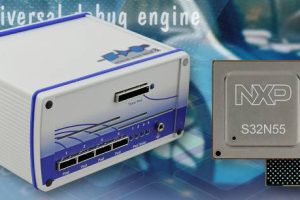
Programmierbare Logik & Systeme is offering debug and trace for NXP’s S32N55 16 core software-defined vehicle processor, announced yesterday. It is included in the 2024 version of UDE, the company’s universal debug engine. With UDE “the Cortex-R52 main cores and the Cortex-M7 auxiliary cores are all visible and can be controlled from one common debugger user interface”, according to PLS. ...