
For example, manufacturing drugs, processing ZBLAN fluoride glass and producing semiconductor seed crystals in microgravity.
Specifically, they are contracted to produce three studies. These will assess technical feasibility, mature key technologies, and develop credible routes to market.
The reports will assess technical feasibility, mature key technologies, and develop credible routes to market.
Space conditions – including extreme temperatures, a natural vacuum and microgravity – potentially enable production that is expensive or impossible on Earth.
The government has already identified ISAM (in-orbit servicing, assembly and manufacturing) as a priority area for UK investment. Indeed, the investment is jointly funded by the UK Space Agency’s Sustainability & ISAM and Unlocking Space programmes.
BioOrbit
BioOrbit wins an award of £250,000 to carry out the ‘PHARM’ study.
This will design an end-to-end mission to manufacture drugs in microgravity. Microgravity enables the formation of more perfect, reproducible protein crystals for drug formulations not possible on Earth.
The UKSA states BioOrbit is working with relevant regulatory bodies to ensure the commercialisation of such a mission will be possible.
OrbiSky
OrbiSky (£295,000) will be responsible for the ‘SkyYield’ study. This will design a payload to process ZBLAN fluoride glass in microgravity.
The UKSA explains that ZBLAN is a specialist optical fibre that can transmit light with up to 100 times less signal loss than traditional silica fibre. This offers significant potential for telecommunications and medical imaging.
Space Forge
Finally, Space Forge (£300,000) will carry out the ‘2Forge2Furious’ study.
This will demonstrate how semiconductor seed crystals could be produced commercially in orbit. It has the aim of improving the efficiency and power density of high-power electronic devices. Possible applications include telecommunications, data centre infrastructure, EV charging and quantum computing.
New markets
“By backing these innovative companies to explore manufacturing in orbit, we’re positioning the UK to capture new markets and bring tangible benefits back to Earth—from better medicines to more efficient electronics,” said Dr Paul Bate, outgoing CEO of the UK Space Agency.
“These studies demonstrate the government’s ambition to drive forward one of the most exciting frontiers of space technology.”
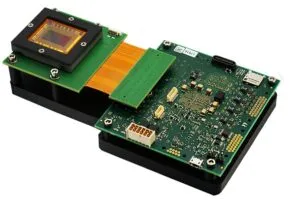
Image: Space Forge
See also: UK space innovation the goal of £20m Westcott Space Hub