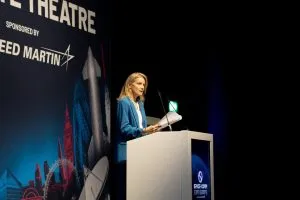

The change comes before the agency is officially ‘folded‘ into DSIT, the UK government’s Department for Science, Innovation and Technology. This merger is expected to complete before April 2026.
Dr Paul Bate
“To be trusted to deliver the government’s civil space ambitions, and to lead an agency of expert professionals who are passionate about their craft, has been the greatest privilege of my career and proof that space is a team sport,” Bate said.
“As the UK Space Agency becomes part of the Department for Science, Innovation and Technology (DSIT), now is the right time to pass the baton on. Whoever is successful will have one of the best jobs in the civil service, leading the new UK Space Agency, delivering innovation and world class science across space, working closely with ministers, and combining policy, strategy, delivery and technical expertise to help make the UK a leading space nation.”
The government announcement highlighted his contribution. He secured record investment levels to the industry, for example, and was part of flagship initiatives such as the National Space Innovation Programme and Space Clusters Infrastructure Fund. Both of which helped increase levels of private investment.
Dr Paul Bate succeeded Dr Graham Turnock as CEO in September 2021.
Change
It was in August 2025 that the UK government announced the change. According to the government, it will be “cutting duplication, reducing bureaucracy and putting public accountability at the heart of decision-making”. The UKSA currently operates as an executive agency of DSIT and its headquarters are at the Harwell Science and Innovation Campus.
The new unit will, however, keep the UK Space Agency name and brand and will have personnel from both organisations. It will be responsible for civil space policy and delivery. Recruitment for a director is currently underway.
Praise
Lord Willetts, chair of the UK Space Agency, said: “Paul has done an enormous amount not just for the UK Space Agency but more widely for the British space sector as a whole. He is an excellent leader committed to promoting British science and technology. All of us at the Space Agency wish him well for the future.”
And Doug Liddle, chair of the UK space trade association, added his commendation: “On behalf of our members, I want to thank Paul for all he has done to champion space across the country and the world.
“I have always appreciated his willingness to engage with companies large and small, to listen to our concerns and to understand the commercial realities of operating in such a fast-moving sector. I wish him well and look forward to working closely with the new director of the UK Space Agency, once appointed.”
DSIT
On the DSIT merger, Bate has supported the change. At the time of the original announcement, in 2025, he commented: “I strongly welcome this improved approach to achieving the government’s space ambitions.
“Having a single unit with a golden thread through strategy, policy and delivery will make it faster and easier to translate the nation’s space goals into reality.
“In coming together, the UK Space Agency and space policy colleagues are building on the firm foundations of economic growth and capability development laid in recent years, including cutting-edge missions, major national programmes, and the regulations that enable UK launch and leadership in space sustainability.”
House of Lords
While there have been industry critics that accountability will be lost and responsibility blur following the change, a recent report from the House of Lords Space Committee welcomed the DSIT merger.
Among its other findings were that current UK spending on space should represent a floor, not a ceiling. And it recommended the establishment of a Space Skills Task Force.
On the UKSA, while recognising the importance of R&D grant funding, the report also recommended the UKSA “realign its funding system to offer more public contract opportunities relative to small-scale grant funding”.
The wider context for the UK Space Agency change, however, is the government’s ‘Plan for Change’. This involves committing to cut red tape and make Whitehall more efficient. NHS England, which it describes as the largest quango in the world, is going as part of this same process.