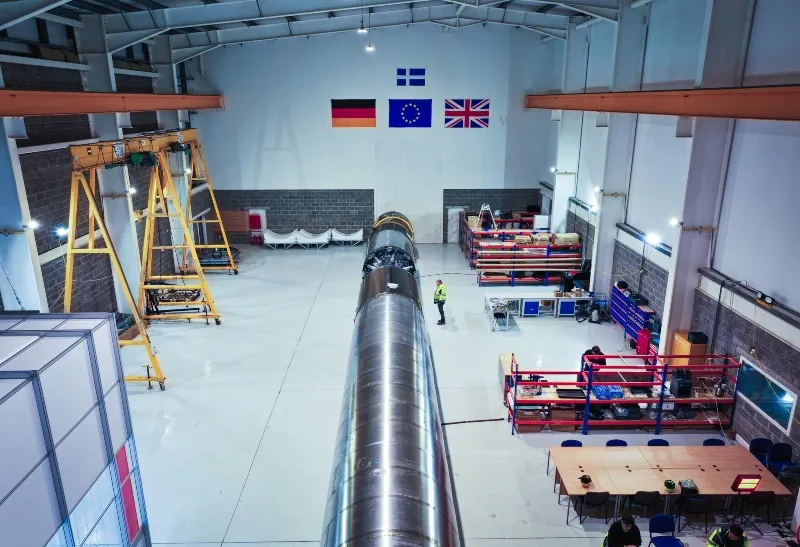
Specifically, the first and second stages of the rocket have now been delivered, an important milestone towards the first test flight, RFA highlights.
The first orbital launch is planned for “summer 2026”, but note that this date has already shifted across 2025.
RFA ONE Stages
The first stage was newly built and tested in Augsburg, before being delivered to the launch site at SaxaVord this February 2026. Here, it will be further integrated with its rocket engines. The nine Helix engines are currently being tested in Sweden and delivered to SaxaVord on a rolling basis, says RFA.
Now, following a successful hot fire test at the Esrange Space Center in Sweden, the second stage has been transported to SaxaVord, too. It arrived safely and is currently undergoing final checks.
Setback
Work has been undertaken on improvements to the Helix engine, tank pressurization systems, and operating procedures, apparently. Previously, in 2024, there were setbacks with an explosion during the testing process for the RFA ONE.
“Following the incident in 2024, we thoroughly reviewed, analyzed, and tested everything and improved the systems to achieve even greater reliability,” said Dr. Stefan Brieschenk, Chief Development Officer at RFA.
“The arrival of our first and second stages at the SaxaVord spaceport is proof of our team’s commitment and expertise.”
Licence to launch
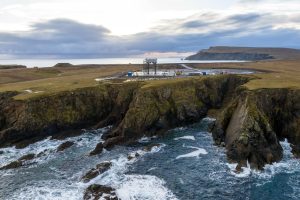
The Bavarian rocket startup has long planned to launch from Shetland. Specifically, it has officially received its spaceflight operator licence from the UK Civil Aviation Authority (CAA). This was for RFA ONE launches from the SaxaVord Spaceport spaceport (above) – on the Lamba Ness peninsula site in Unst.
Note, a spaceport licence and range control licence are already in place for SaxaVord. It means all three critical regulatory licences required for a test flight are active. Granting responsibilities for the licences lie with CAA.
The awards were of historic significance for two reasons. RFA became the first European company to receive such a licence for vertical launches of a privately developed orbital rocket.
They also give a green light for Scotland to host the first European vertical launch. (Norway’s Andøya Spaceport is a close rival.)
Polar orbits
Why did RFA choose SaxaVord as the base for RFA ONE flight operations? It explains the decision itself, as follows.
“[This] was a decision made after careful consideration of various factors. Firstly, SaxaVord and RFA are both private companies who share the same approach of cost-efficiency, a fast pace and “go-get-it”-mentality. Secondly, Shetland has a rich oil and fishing industry with existing infrastructure (e.g. industrial harbors, tool stores, suppliers). Finally, it is perfectly located for launches into polar low earth orbits.”
“While launching from the equator provides additional speed from the Earth’s rotation, this advantage is primarily relevant for higher or further orbits (e.g., GEO, Lunar, or interplanetary). For our purposes, proximity to the equator is not a crucial factor since we will be launching in a direct north/south direction. We’re primarily targeting polar and sun-synchronous orbits as that is the optimal location for the more commercially interesting constellations and Earth Observation (EO) satellites.”
RFA CEO
Last year, in April, it appointed a new CEO, Prof. Dr. Indulis Kalnins.
The intention was for Kalnis to lead RFA to achieve the first launch of its three-stage RFA ONE rocket.
Image: RFA
See also: RFA completes full duration upper stage hot fire, European first