ISO’s Technical Committee TC 22 (Road Vehicles) has launched standardization work on OSP as a new work item within ISO/TC22/SC31/WG3. The official kick-off is planned for February 2026.
The work is listed under ISO 26341 1, reflecting growing auto industry demand for open and interoperable communication technologies in software-defined vehicles (SDVs).
“We are thrilled that so many companies see OSP as necessary to become a new international standard,” says Dr. Jörg Strauß, Head of the Business Line Mobility and Illumination at ams OSRAM. “We would like to thank all our supporters and partners, and we look forward to working together with the industry on OSP for many years to come.”
OSP, short for Open System Protocol, was developed by ams OSRAM to address a key challenge in modern vehicle electronics: efficiently connecting and controlling a growing number of intelligent endpoints such as RGB LEDs, drivers, sensors, and actuators at the edge of the vehicle network.
OSP enables a single central controller, typically a microcontroller, to manage up to 1,000 intelligent nodes. In automotive architectures, OSP acts as the ‘last-mile’ network, connecting lighting elements and other smart devices directly to higher-level vehicle backbones such as CAN or Ethernet.
Implementations based on 10BASE-T1S have already been demonstrated, underlining OSP’s suitability for modern zone- and domain-based electrical/electronic (E/E) architectures.
The Open System Protocol is already used in series production today. ams OSRAM offers OSP-enabled devices, such as the intelligent RGB LED OSIRE E3731i and the Stand-Alone Intelligent Driver (SAID), both of which are currently deployed in vehicles approved for road use.
In addition, first LED and IC manufacturers are now integrating OSP into their products, while several microcontroller suppliers already offer controllers or gateways with an integrated OSP stack.
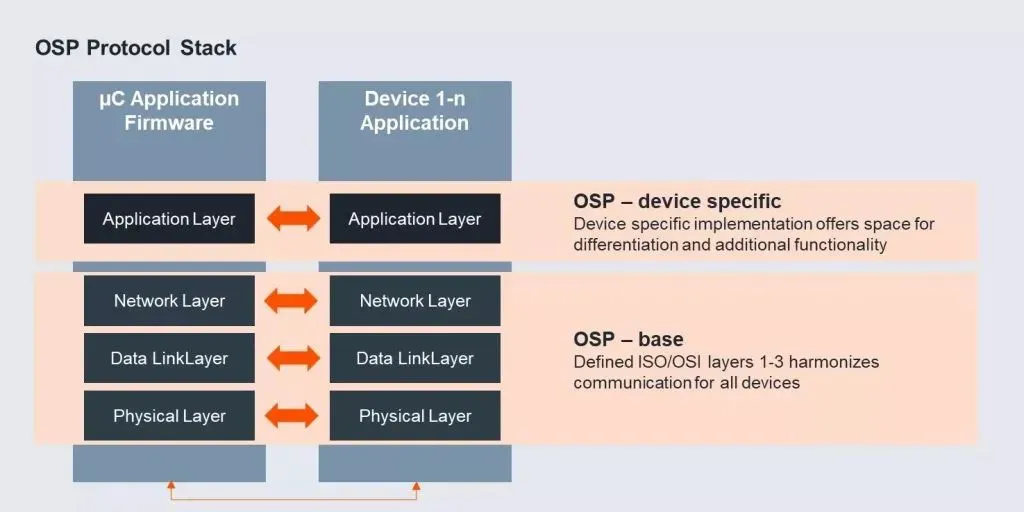
From the outset, OSP was designed as an open, license free protocol, available to anyone at no cost. Only the base protocol is standardized, deliberately leaving room for innovation and differentiation on the application layer.
The OSP specification has been publicly released, and the corresponding software is available free of charge on GitHub.
With the handover to ISO, OSP now enters the formal standardisation process, a step that many OEMs and suppliers consider essential for long-term adoption in safety-critical automotive environments.
More: here.