While Germany, the United Kingdom, and France led the market with 435,549 to 856,540 new EVs sold last year, their adoption relative to population tells a different story.
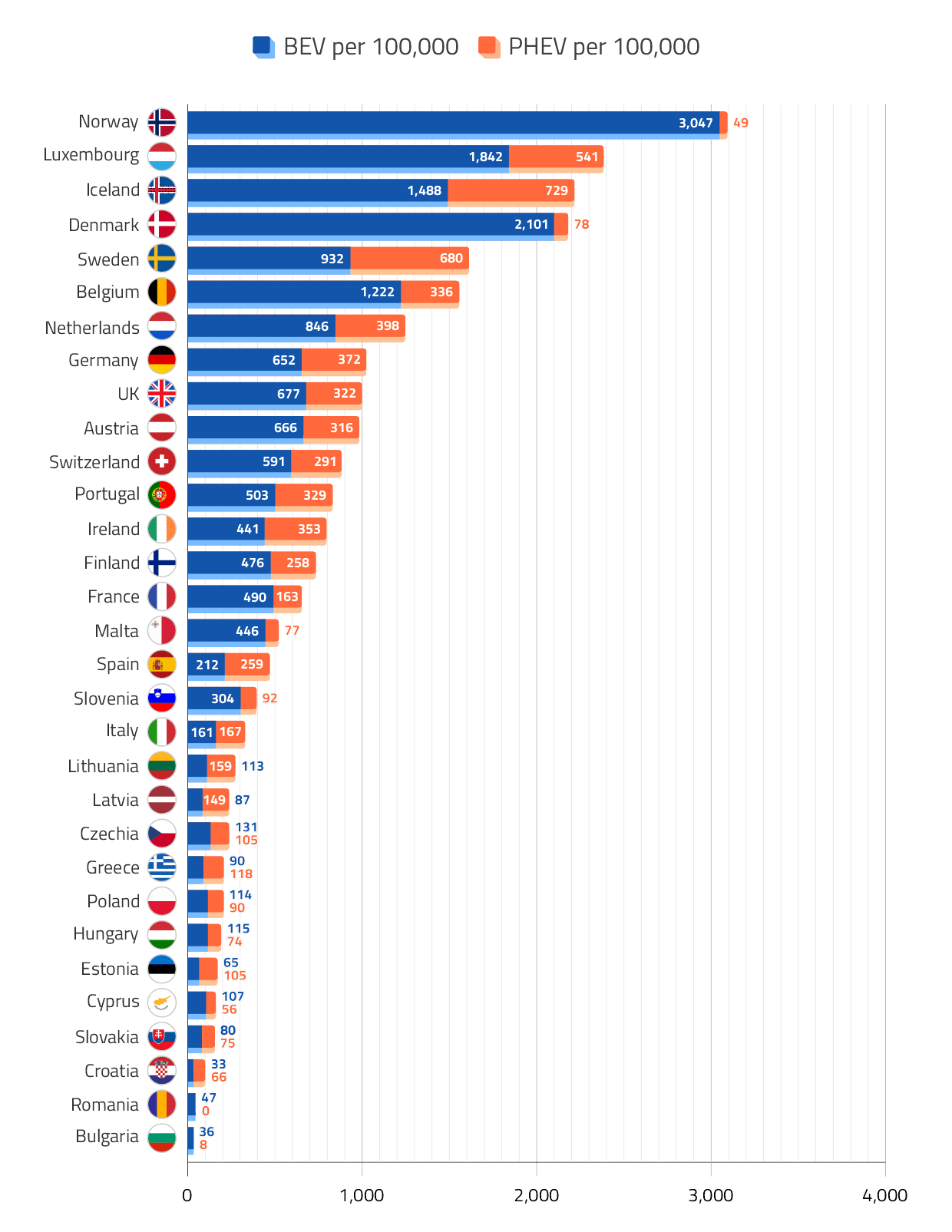
Germany ranks 9th and the UK 8th per capita, while France falls to 16th with 653 EVs per 100,000 people.
By contrast, smaller markets like Norway and Luxembourg register the highest per-capita adoption, with 3,096 and 2,383 EVs per 100,000 inhabitants, highlighting how population size and market scale can mask the pace of EV uptake.
Here are the European countries with the most EV sales per 100,000 people (2025 totals):
Norway – 3,047 BEV + 49 PHEV = 3,096 EV sales per 100K
Luxembourg – 1842 BEV + 541 PHEV =2,383 EV sales per 100K
Iceland – 1,488 BEV + 729 PHEV = 2,217 EV sales per 100K
Denmark – 2,101 BEV + 78 PHEV = 2,179 EV sales per 100K
Sweden – 932 BEV + 680 PHEV = 1,612 EV sales per 100K
Belgium – 1,222 BEV + 336 PHEV = 1558 EV sales per 100K
Netherlands – 846 BEV + 398 PHEV =1,244 EV sales per 100K
Germany – 652 BEV + 372 PHEV = 1024 EV sales per 100K
UK – 677 BEV + 322 PHEV = 999 EV sales per 100K
Austria – 666 BEV + 316 PHEV = 982 EV sales per 100K
In 2025, Germany led European EV sales with 856,540 new registrations,including 545,142 battery-electric vehicles (BEVs) and 311,398 plug-in hybrids (PHEVs).
The United Kingdom followed with 698,491 units (473,348 BEVs and 225,143 PHEVs), while France registered 435,549 EVs (326,922 BEVs and 108,627 PHEVs), with the Netherlands rounding out the top four at 229,584 (156,139 BEVs and 73,445 PHEVs.)
Germany’s EV sales surged over 49% year-on-year, the UK grew by 27%, and the Netherlands saw a 24.2% increase.
France was the only major market to experience a slight decline, with overall EV registrations falling 0.3%, driven by a 25.8% drop in PHEV sales.
On a per capita basis, the picture shifts markedly. Norway leads both in EVs per capita, with 3,096 per 100,000 citizens, and in the share of EVs among new registrations, exceeding 97%.
Luxembourg follows with 2,383 EVs per 100,000 inhabitants, while Iceland and Denmark register 2,217 and 2,179 units per capita respectively.
At the lower end of the spectrum, Bulgaria and Romania sold just 45 and 47 new EVs per 100,000 people, with both countries recording a very low share of EVs among new car registrations, under 7%.
EV sales grew most sharply in Poland (+141%), Lithuania (+119%), and Latvia (+115%), though their share of total new car registrations in 2025 remained relatively modest, between 12% and 19%.
By contrast, Malta (-16%), Estonia(-12%), and Romania (-10%) saw declines in EV registrations.
Belgium also recorded a 5.6% drop, largely due to a more than 40% decrease in plug-in hybrid sales, even though the country ranks 8th in Europe for EV market share at 44.23% and 7th in total units sold, with 183,433 vehicles.
In 2025, Europe’s new car market continued its shift toward electrification, with hybrid electric vehicles (HEVs) leading sales at 4,566,850 units, representing 34.4% of total registrations.
Battery-electric and plug-in hybrid vehicles combined (EVs) accounted for 3,858,088 units, or 29.1% of the market, surpassing petrol cars, which totaled 3,467,041 units (26.1%).
Diesel vehicles made up just 7.7% of new registrations, while cars powered by other fuels contributed 2.7%.