

The UK Engagement with Space Committee found the current strategy “ambitious but insufficiently focused”. It risks spreading resources too thinly, says the committee. “A targeted approach is essential for maximising the impact of public investment and fostering successful space businesses in the UK.”
Space age
“Only the most strategic and forward-looking nations will capture the economic and scientific rewards of this new space age,” said Baroness Ashton, chair of the committee.
“With the right leadership, co-ordination, and investment, the UK can be there. Space is transforming the world and our report found much to be positive about. Britain should play a role in leading this transformation. If not, it risks being left behind.”
Findings
Among its other findings were that current UK spending on space should represent a floor, not a ceiling. It recommended the establishment of a Space Skills Task Force. And it welcomed the folding of the UK Space Agency (UKSA) within DSIT (the Department for Science, Innovation and Technology).
On the UKSA, while recognising the importance of R&D grant funding, the report recommends the UKSA “realign its funding system to offer more public contract opportunities relative to small-scale grant funding”.
Also, noting the UK’s status as a mid-sized space power, it said that international collaboration is essential in delivering its strategic aims in space. And it states ensuring access to finite radio spectrum should be a priority when it comes to UK space and telecoms policy.
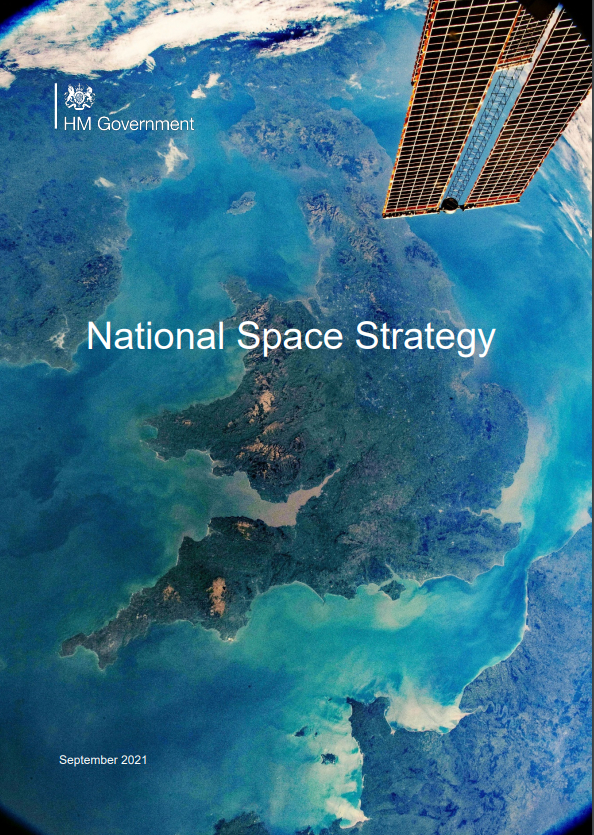 Note that it considered the National Space Strategy – published in 2021 – as a good first step in “establishing a coherent, cross-government space strategy that functions as a lodestar for government, industry and academia”. However, subsequent follow-ups do not “provide detailed and costed implementation plans that can provide certainty to stakeholders”.
Recommendations
To summarise, the report has eight main recommendations for the UK government.
First, provide a more coherent strategic direction with clear delivery plans. “The UK space sector lacks the strategic direction necessary for success,” it says.
Second, there should be a focus on the development of multi-use technologies. “The UK’s space strategy must prioritise those national capabilities which meet UK security and defence requirements as well as offering multi-use potential for commercial exploitation and sectoral growth in the UK.”
Third, ensure that structures of government are “adequate to deliver cross-governmental space policy”.
Fourth, the UK’s space funding model needs reforming, to allow firms to grow and scale.
Fifth, to ensure the UK “remains a world-leader in future space regulation”.
Sixth, address skills challenges within the space sector.
Seventh, adopt a strategic approach to international partnerships.
And finally, “promote space safety and sustainability on the international stage”.
Infrastructure
For context, the report found that the value of space to modern society is still underappreciated. Specifically, that satellite technology is fundamentally intertwined with the modern UK economy, underpinning multiple critical economic sectors. It believes 18% of GDP is underpinned by such satellite services.
In fact it deemed such services to be Critical National Infrastructure, the disruption of which would create significant challenges across British society. Noting the potential for disruption, it said: “The UK has a strong capability in space weather, but it requires sustained investment and support to maintain its strength.”
You can read the publication online, on the Parliament.UK website.
Leading figures from the UK space industry appeared before the cross-party Lords Committee in June. This was to discuss the space economy, issues around domestic launch capability and implications for national security.
Image: Clearspace