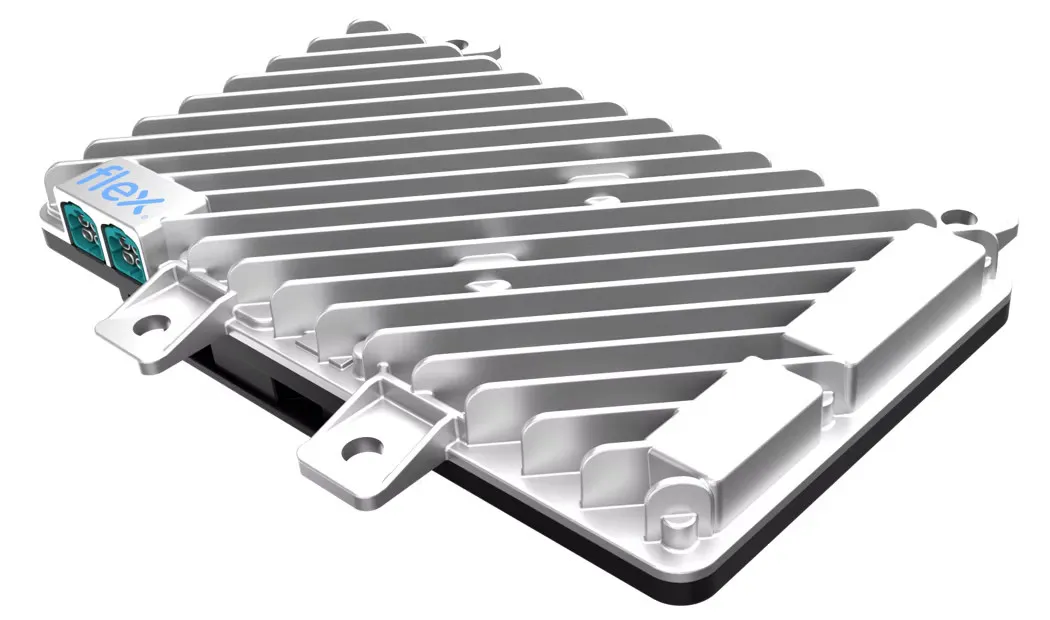
“The development kit follows a scalable approach and is based on reusable assets, combining approximately 30 building blocks. This allows developers to configure different zone control unit implementations flexibly, and offers a path to series implementation,” according to Infineon.
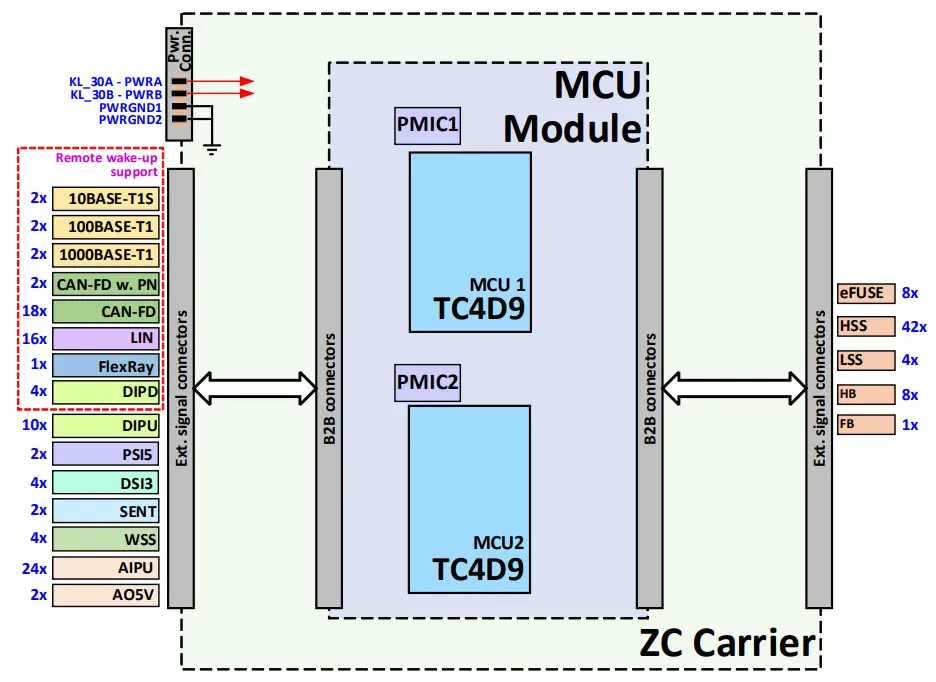
It has dual microcontrollers for fail-safe operation, with up to 2x 6,810Dmips real-time performance backed by up to 2x 10Mbyte ram and 2x 21Mbyte non-volatile memory.
These are pluggable, and can be replaced with a single MCU.
 Internal hardware accelerators are available for cybersecurity including protection over-the-air software updates.
Among Ethernet interfaces are 2x 1000BASE-T1 (1x can be upgraded to 2500BASE-T1), 2x 100BASE-T1 and 2x 10BASE-T1S.
For CAN communication there are 2x 5Mbit/s CAN-FD interfaces with ‘partial networking’ (for selective wake-up networked ECUs while others sleep), then 18x 5Mbit/s CAN-FD without partial networking.
Other interfaces include: 16x LIN, 1x 10Mbit/s Flex Ray, 2x 125kbit/s bidirectional PSI5, 4x DSI3 (for up to 12 ultrasonic sensors), 2x SENT (upgrade path to SPC protocol with master trigger) and 4x WSS three-wire wheel speed sensor (upgrade path to two-wire).
There are discrete signal inputs and outputs: 4x pulled down digital input, 10x pulled-up digital input, 24x pulled-up analogue input and 2x 5V analogue outputs.
For power control there are: 8x e-fuses (with hardware i2t protection), 42x high-side switches, 4x low-side switches, 8x half-bridges for motors, and one full-bridge for brushed motors.
The unit itself has two reverse-polatity-protected power supply inputs for redundant operation, and can shed functions to operated down to 5mA.
“With the development kit’s building block concept, developers can right-size their designs for many individual implementations while preserving feature headroom for future models,” claimed Infineon.
Find the dev kit in meeting room LVCC West W307 at CES 2026, or on this Infineon web page