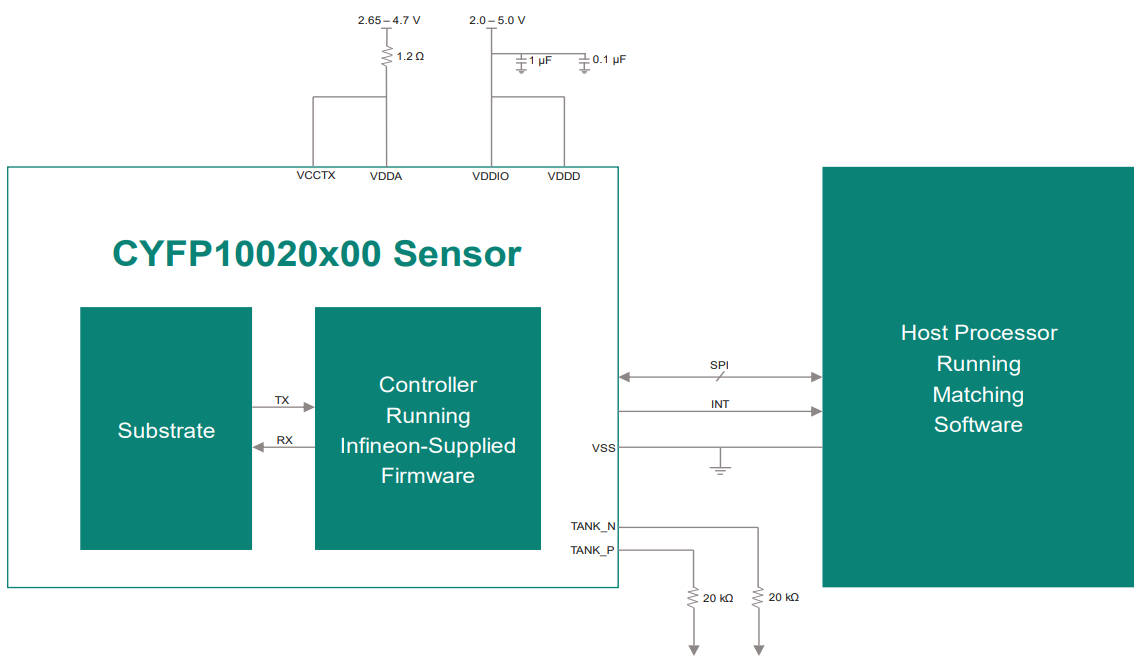
They are very similar, but CYFP10020A00 works over -40 to +85°C, while CYFP10020S00 operates up to +105°C.
As well as fingerprint reading, finger touch-down and lift-off are detected, and the sensors can act as a miniature track-pad by analysing fingertip movement acrosss the device.
Sensing is capacitive, with a 107 x 107 pixel matrix spread over 8 x 8mm (340dpi) on top of a 8.9 x 9.3 mm BGA package containing the processing silicon including an Arm Cortex-M0 with Infineon’s fingerprint firmware.
Fingerprint data acquired in around 160ms, encrypted by on-chip AES hardware and output via an SPI interface to the host MCU.
According to Infineon, it has nise-suppression technologies against such sources as battery chargers, displays and radios, and is both self-calibration and self-testing – no field tuning is required.
Claimed error rates are <1.5% FRR (false recognition rate) and FAR (false acceptance rate) >1:100K using recommended matching host software, which requires a Cortex-M4, 256kbyte of flash and 96kbyte of ram.
Performance can be maintained through customer-applied polymer, plastic or ceramic coatings under 100µm thick.
Operation can be from a single 3.3V supply, with <80mW average active power while sensing, typically 8µW typical deep-sleep, and 400µW finger detection at 10 detect/s.
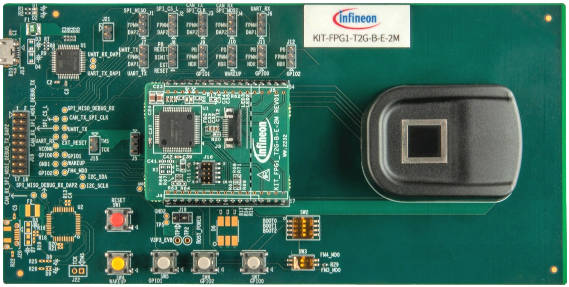 An evaluation kit (KIT-FPG1-T2G-B-E-2M) is also available.
Use is expected for in-vehicle personalisation, and payment authentication for charging or parking, as well as non-automotive authentication and identification.
Find the fingerprint sensor web page here. Data sheets are merely two page briefs, and there is a tiny bit more here.