Posted on 27th November 2019 | Modified on 12th December 2019
Memory, News
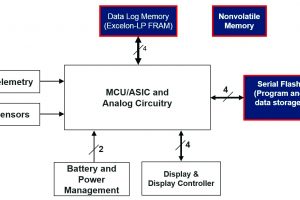
Some low-power strategies work for expanding memory storage in portable and implantable medical devices, says Shivendra Singh. The first challenge for system architects is to identify the right system on chip (SoC) or microcontroller to serve as the heart of the system. It must be capable of providing the desired performance while simultaneously reducing the overall system’s power budget. Peripheral ...
Posted on 8th November 2019 | Modified on 8th November 2019
Business, Memory
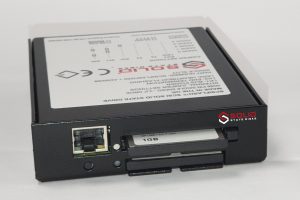
HotBackup is a solid state ‘live host’ backup for use in mission critical legacy systems
Posted on 24th February 2016 | Modified on 24th February 2016
Embedded Systems, Memory
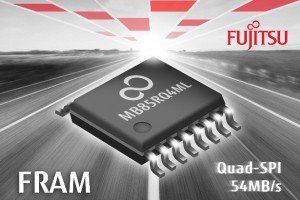
Fujitsu has launched a 4Mbit ferroelectric RAM (FRAM) with a quad SPI interface at Embedded World in Nuremberg. Called, MB85RQ4ML, with its four bi-directional I/O pins operating at 108MHz it can reach a data transfer rate of 54Mbyte/s. “In this respect, MB85RQ4ML is over four times as fast as our existing parallel 4Mbit FRAM device and even outperforms the 45ns parallel SRAM,” said ...
Posted on 15th February 2016 | Modified on 19th February 2016
Memory, News
Rutronik Embedded is offering a solid-state drive (SSD) from Transcend in a 2.5-inch form factor with integrated SLC NAND flash memory and a SATA III 6Gbit/s interface. The SSD570 has sequential read/write performance of up to 510Mbyte/s and 450Mbyte/s respectively. It comes with a built-in IPS function that assures more data volume being written into flash chips in the event ...
Posted on 19th January 2016 | Modified on 19th January 2016
Memory, Memory, News
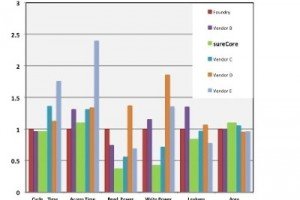
sureCore, the Sheffield SRAM IP specialist, today announced the immediate availability of its 28nm FDSOI memory compiler. The compiler supports the company’s low power, single port SRAM IP and dual port SRAM IP for 28nm FDSOI process technology. It offers capacities up to 1Mbit with word lengths up to 288bits and supports 4, 8 and 16 Mux factors. According to the ...
Posted on 9th December 2015 | Modified on 11th December 2015
Memory, News, Research
Researchers from the Universities of Glasgow and Leeds have developed materials for implementing racetrack memory. Racetrack memory uses lines of nanowires. Electricity passed through the wires creates ‘domain walls’ – spaces between the wires where information can be stored. Materials are still a key question for implementing the technology. The team from Glasgow and Leeds used electron microscopy to look ...
Posted on 22nd October 2015 | Modified on 22nd October 2015
Memory, News
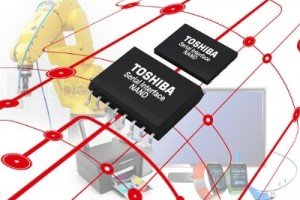
Toshiba’s latest range of NAND flash memory chips have a serial interface. The advantage of the serial interface is that the devices can be controlled with just 6-pins, and this means they can be used as low-pin count SLC NAND flash memory. SLC NAND flash memory is now being used as a higher capacity alternative to NOR flash memory in some embedded ...
Posted on 17th August 2015 | Modified on 18th June 2025
Memory
Micron Technology’s legacy DRAM modules (SDR/DDR) will be manufactured by ATP following a license agreement between the companies. Micron published EOL notices for these SDR and DDR DRAM modules in January 2015 with a Last Time Buy (LTB) in July 2015 and a Last Time Ship (LTS) in January 2016. Taiwan-based ATP will continue to manufacture these DRAM modules specifically for the ...
Posted on 11th August 2015 | Modified on 25th June 2025
Memory
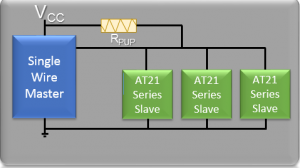
Atmel has designed a self-powered EEPROM which requires only two-pins—a data pin and ground pin – for operation. As the devices are self-powered, there is no need for a power source or Vcc pin, with a parasitic power scheme over the data pin. These single-wire EEPROMs have a specified power standby of 700nA, 200µA for write current, and 80µA for ...
Posted on 23rd March 2015 | Modified on 23rd June 2025
Memory
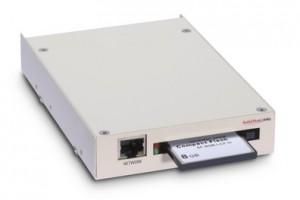
Solid State Disks has launched an Ethernet-based back-up and restore capability for its family of Compact Flash (CF) SCSI-Flash solid-state drives for storage systems on legacy semiconductor manufacturing equipment.