A COTS processing module based on 13th Gen Intel Core i7 processor has been developed by Curtiss-Wright and Green Hills Software.
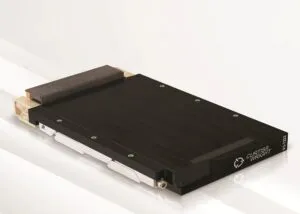
Designed for safety-critical avionics systems, the Curtiss-Wright V3-1222 is based on the company’s SOSA-aligned V3-1222 3U VPX processing module and Green Hills Software’s FACE (Future Airborne Capability Environment) -certified Integrity-178 tuMP real-time operating system (RTOS). The two companies say the module delivers an “efficient and proven path to deploy open standards-based advanced multicore systems in environments that demand the highest levels of functional safety assurance, including airworthiness certification”.
The single-clot 3U VPX module’s 13th Gen Intel Core i7 processor combines six performance-cores and eight efficient-cores, and integrated Intel Iris Xe graphics.
The Integrity-178 tuMP RTOS supports both bound multi-processing (BMP) and symmetric multi-processing (SMP), which allows specific workloads to be assigned to optimal core types to maximise throughput and determinism. The RTOS runs multiple workloads in parallel to execute a multi-threaded, safety-critical workload across multiple cores. This means power efficiency and determinism can be optimised by assigning tasks that are high-priority but lower in processing requirements to the more efficient E-cores.
Board-level features on the V3-1222 include a CardFail signal tied to onboard built-in test capabilities, and support for high-bandwidth PCIe Gen 3 lanes to accelerate data throughput in system architectures. It also includes computing features to protect against physical and remote attacks.
The Integrity-178 tuMP RTOS provides a MILS (multiple independent levels of security) operating environment capable of hosting multi-level security applications and has been used to meet USA’s National Security Agency’s “Raise the Bar” security standard for cross domain solutions.
The module can support system developers targeting the highest Design Assurance Level (DAL A) certification objectives, including compliance with A(M)C 20-193/DO-178C and A(M)C 20-152A/DO-254 guidance.
Suitable applications are certifiable multicore computing, including tactical radar systems, flight control computers, and sensor fusion in defence applications, digital cockpit systems, primary and multifunction displays, enhanced flight vision systems in commercial aviation and autonomous flight control, safety-critical robotics, and electric vertical takeoff and landing (eVTOL) platforms.