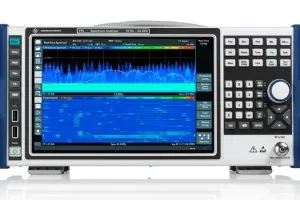
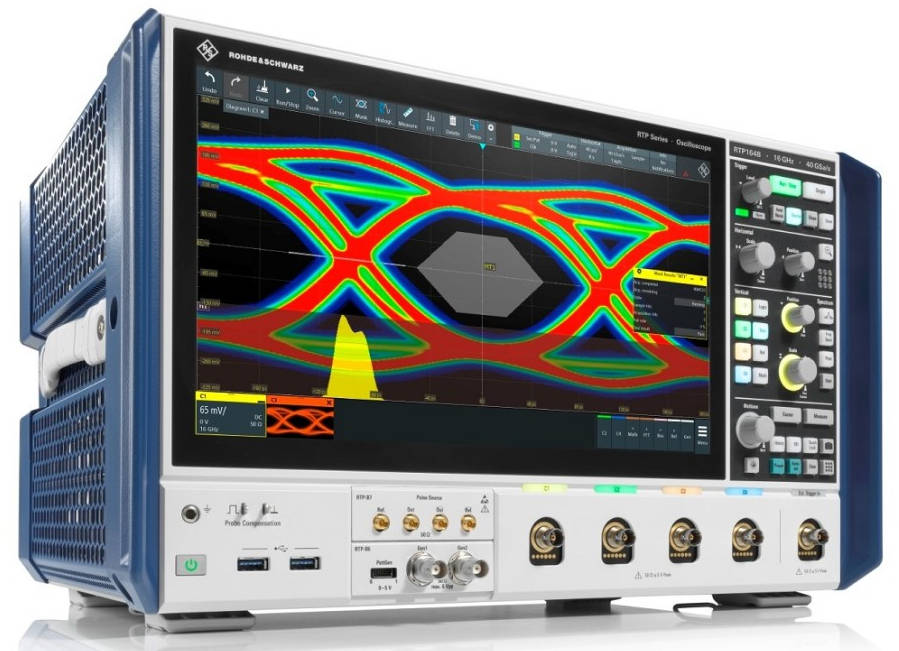
“Improving overall usability so that test engineers could focus on the design problems at hand and not on operating the test equipment was paramount to our R&D engineers when we decided to update the R&S RTP,” said company oscilloscope president Andreas Werner.
According to the company, foot print remains the same – dimensions are 463 x 285 x 349mm with handles or 441 x 285 x 316mm with shock protection.
Amongst the scopes, a maximum sample rate of 40Gsample/s can be found, built around the company’s acquisition and processing asic which can work up to an acquisition rate of 750,000waveform/s. Standard acquisition memory is now 100Mpoint/channel, upgradeable to 3Gpoint/channel.
Hardware implemented 16Gbit/s clock data recovery is provided for long-term real-time serial interface eye diagram monitoring, and new options, RTP-K136 and K137, support data eye analysis of sequential bits in an acquired data stream up to 8 and 16Gbit/s – timing for bit slicing relies on continuous clock data recovery. “This has significant advantages relative to traditional post-processing with a software-based clock data recovery, claimed the company. “Users can combine this function with the real-time deembedding and real-time differential math functions of the RTP to complete debugging or searches for signal faults.”
New features include the RTP-K39 user-defined maths option, allowing a Python script to be recalled for complex calculations, and to display the results as a maths signal on the oscilloscope, as well as a set of compliance test that work with the company’s ScopeSuite test framework:
- RTP-K27 MIPI D-PHY V2.1/2.5
- RTP-K28 MIPI C-PHY V2.1
- RTP-K102 USB 3.2 Gen 1 & 2 RX
See large screen RTP oscilloscopes at Embedded World in Nuremberg (21 – 23 June 21) at booth 4-218.
The Electronics Weekly stand is at 4A-628. Come and say hello if you’re at the show.