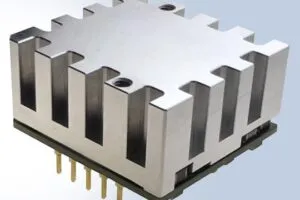
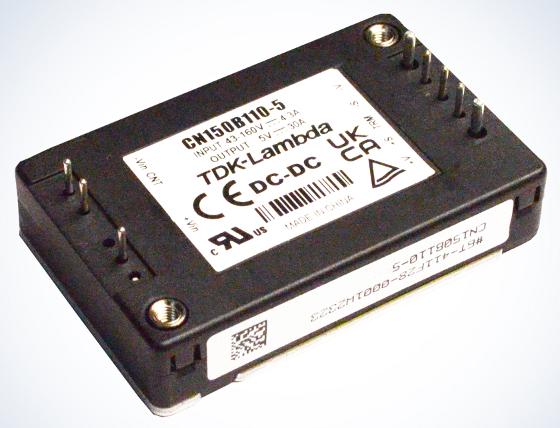
“The converters are compatible with 72Vdc or 110Vdc nominal railway systems for applications such as rail rolling stock and trackside equipment,” according to the company.
Output choice is 5, 12, 15, 24 or 48V depending on model, and efficiency in the range peaks between 88 and 92%.
“Using the trim function, they can be adjusted using a resistor or an external voltage to compensate for voltage drops or to accommodate non-standard system voltages,” according to the company.
Spacing between primary input and baseplate supports a 2.5kVac isolation voltage, Input-to-output isolation is 3kVac, and 500Vac can be withstood between the output and the baseplate.
Operation is over -40 to +100°C on the baseplate, with some derating at high temperature, and up to an altitude of 5,000m.
Cooling is through optional heatsinks, or a cold plate.
Remote on-off is standard, an there is an optional 7 to 11V 10mA auxiliary output if the negative remote sense can be foregone.
Other options include board coating, unthreaded mounting holes, shorter pins (3mm), and no encapsulation (not 150W version).
Dimensions are ~ 12.7 x 37 x 58mm.
Marking is CE and UKCA marks for Low Voltage and RoHS Directives, and they are certified to IEC/UL/CSA/EN 62368-1 safety standards.
In addition, the series meets the rolling stock IEC 61373 Category 1, Class B shock and vibration, and is designed to meet EN 45545-2 railway fire protection and EN 50155(1) for railroad vehicles.
Find the CN-B110 series on this web page