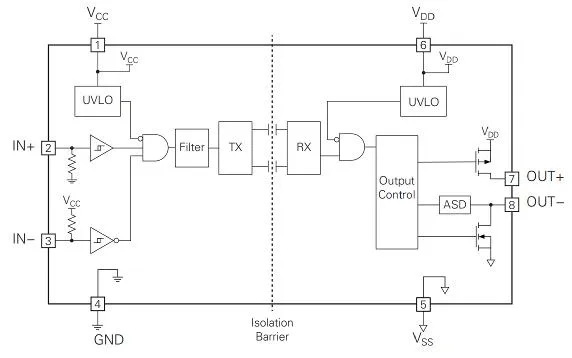
IX3407B, as it will be known, uses a 2.5kV capacitive isolation barrier (3kV for 1s) and can withstand 150kV/μs transients.
The inputs’ thresholds are compatible with 3.3V logic and there are separate pull-up and pull-down outputs so that resistors can be used to suit various silicon mosfet, SiC mosfet and IGBT gates.
The input side needs a power supply between 3.1V and 17V, and the output side needs between 13V and 35V. Both sides have under-voltage lock-out, which holds the output low until both supplies are established.
Typical propagation delays are 154ns turn-on (247ns max) and 162ns turn-off (261ns max).
Rise times are typically 10ns on or off, (20ns max).
Overall pulse width distortion is typically 7.5ns (27ns max) and nominally switching is at up to 1MHz.
One unusual feature, a compliment to the under-voltage lock-out, is an active output shut-down that drains charge from the driven transistor’s gate if there is insufficient output-side voltage to operate the internal pull-down mosfet.
Its effect is to turn off the driven transistor should the output-side supply fail.
Packaging is wide-bodied SOIC-8.
Industrial and renewable energy applications are foreseen, including motor drives and solar inverters.
Find IX3407B on this Littelfuse web page
Toshiba has used opto-isolation in this 5A mosfet and IGBT gate driver