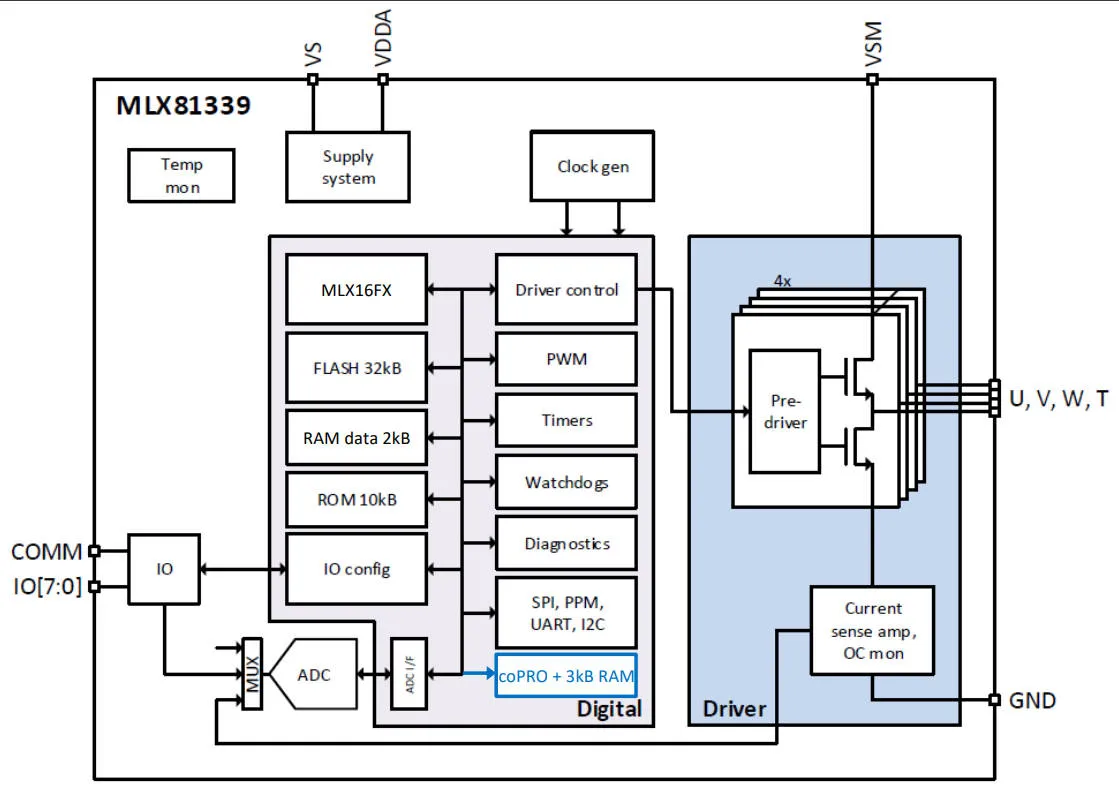
A CPU is included and both sensor-less and sensor-based feedback can be implemented.
“For applications requiring flexibility in configuration, MLX81339 offers flash programmability,” said the company. It “ensures reliable start-up, stopping and precise speed control from low to maximum speed”.
A web based tool, ‘StartToRun’, is available to generate configuration files and includes pre-filled mechanical value suggestions.
Operation is across 6 to 26V and -40 to +125°C (150°C junction) – 40W is available when supplied with 24V, dropping to 20W at 12V.
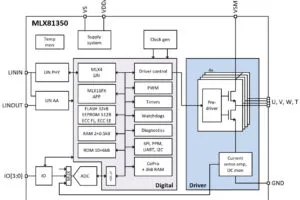
Inside, a 16bit CPU is backed by 32kbyte of flash and 2kbyte of ram – clocking can be at 24, 28, 32 or 36MHz.
Peripherals include 5x 16bit motor PWMs, 2x 16bit timers, 1x 14bit timer and a <2µs ADC (13bit ±4A current, 12bit voltage and temperature).
Current output is configurable up to 3A, and over-current protection is provided alongside under-voltage, over-voltage and over-temperature protection.
Control can be via PWM, FG, I2C, UART or SPI, and there are eight general-purpose IO connections in the QFN24 packaged version – there is also a simpler SO8 version.
Industrial, commercial consumer and, through AEC-Q100 qualification, automotive appliclications are foreseen
Find the programmable MLX81339 on this Melexis web page.
A code-free configurable version, MLX80339, is scheduled to appear at the beginning of next year.
EPC recently announced a GaN-based driver specifically for motorised humanoid robot joints.