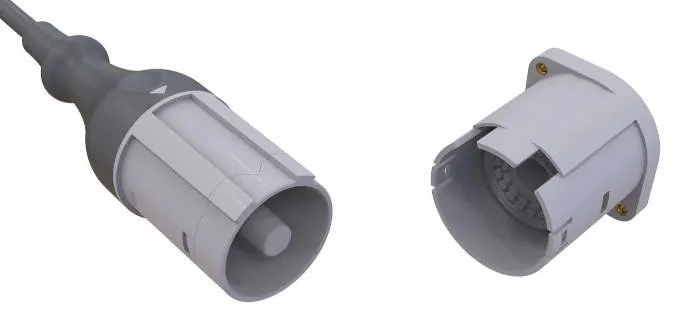
All pins are rated to carry 1A and contact resistance is under 8mΩ.
To reach full operating potential, the terminations of the cable-mount plug and PCB-mount receptacle must be potted with epoxy.
The ~40mm diameter connector, called TheraVolt, is aimed at medical equipment.
“Trends in electrophysiology, most notably the adoption of pulsed field ablation, are driving demand for medical connectors that support higher pin count densities,” said the company. “High pin count and high voltage clearance is particularly valuable in treatments with multiple therapy options, complex functions and expanded data collection.”
Operation is over -35 to +65°C (confirmed by Electronics Weekly, some documents erroneously suggest +85°C), and it can also be sterilised in a steam autoclave for 10 minutes at 135°C.
The connector is rated for 1,000 connect-disconnect cycles. However, the company said: “The initial design uses a hyperboloid signal terminal capable of up to 30,000 mating cycles.” Maximum insertion force is 53.4N and minimum extraction force is 35.6N.
The high-voltage contacts are arranged in pairs – why?
In high-voltage applications, connectors often appear in pairs because the system involves at least two electrodes that must be connected simultaneously,” Molex told Electronics Weekly. “Each electrode carries the same high voltage level at the same time, or another possibility would be to have a sensor coupled to it. Pairing connectors helps to ensure that electrical connections are made correctly and safely, preventing accidental mismatches and ensuring consistent voltage reference points.
Versions with up to 220 contacts are in the pipeline.
This Molex web page is a reasonable starting point for gathering information on TheraVolt.
ODU also makes high-voltage autoclaveable medical connectors