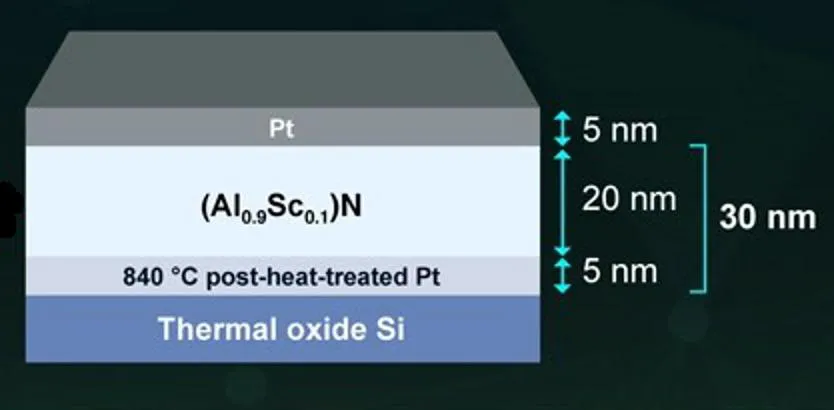
It “demonstrates strong electric polarisation despite being just 30nm thick including top and bottom electrodes, making it suitable for high-density electronics,” according to the Institute. “This demonstrates good compatibility with semiconductor devices combining logic circuits and memories.”
The key material that demonstrates high remanent polarisation is a scandium-doped aluminium nitride film – wurtzite structured (Al0.9Sc0.1)N which achieved 100µC/cm2.
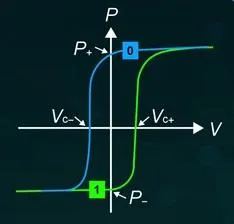 While power is required to switch polarisation, the polarised state is retained after power is removed, making the technology suitable for non-volatile memory.
30nm includes the whole material stack, 5nm of platinum, 20nm of the nitride and a 5nm platinum top electrode.
“Previous research on downscaling ferroelectric memory has only focused on thinning the ferroelectric layers,” said Professor Hiroshi Funakubo. “What makes our research stand out is that we focused on down-scaling the complete device stack, not just the ferroelectric film.”
Heat treating the bottom platinum electrode at 840°C, which enhances crystal orientation, was one of the steps found necessary to preserve ferroelectric performance as thinner and thinner active layers were tried.
“Overall, the study could inspire down-scaling of other ferroelectric architectures such as FeRAM and FTJ, which rely on stable polarisation switching and retention,” said the Institute.
The Institute of Science Tokyo worked with Canon Anelva on this research.
Their findings are published as ‘Thickness scaling of integrated Pt/(Al0.9Sc0.1)N/Pt capacitor stacks to 30nm‘ in Advanced Electronic Materials.