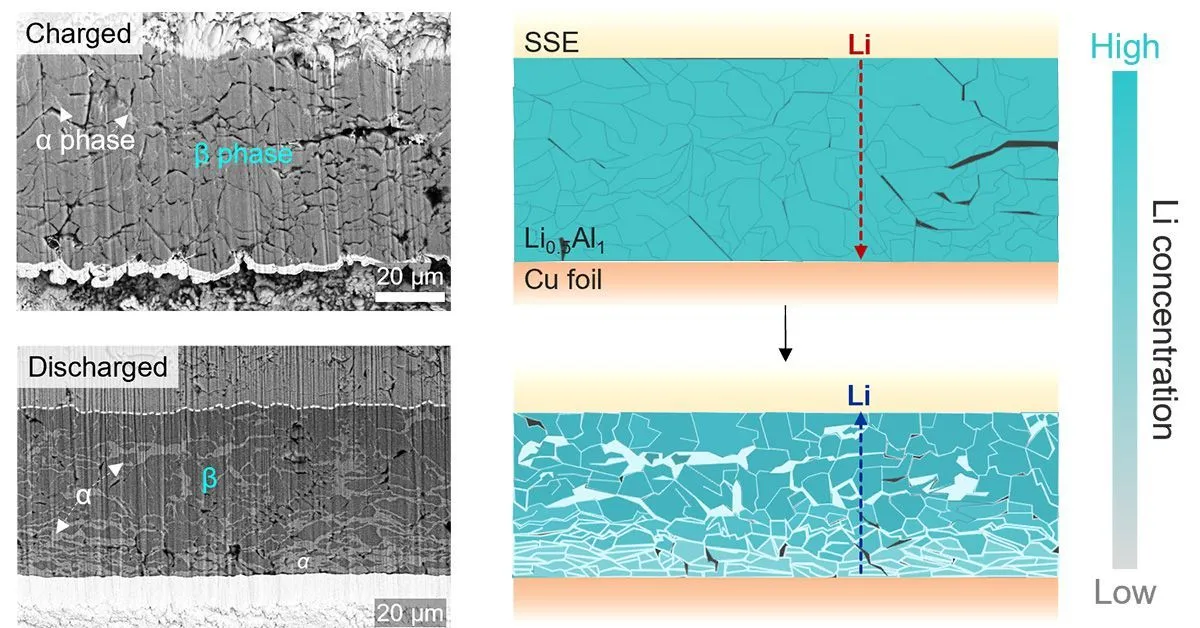
They studied how lithium ions move through two phases of the material: lithium-rich ‘beta’ and lithium-poor ‘alpha’.
Increasing levels of beta phase provided pathways for lithium ion diffuse “up to ten billion times faster than through the alpha phase”, according to the university. “The beta phase also led to denser, more stable electrode structures and enhanced channels of lithium diffusion between the electrode and solid electrolyte.”
Performance improvements were significant once the amount of aluminium was less than double that of lithium.
It added that beta phase-enriched electrodes maintained capacity over 2,000 cycles to 83% capacity. The full cell here was Li0.5Al1 – LiNi0.8Co0.1Mn0.1O2 – the latter is ‘NCM811’.
UC San Diego worked with UC Irvine, UC Santa Barbara and (provider of NCM811) LG Energy Solution.
The work is published in Nature Communications as: ‘Lithium diffusion-controlled Li-Al alloy negative electrode for all-solid-state battery‘, which is an extensive and clearly-written paper (with a long methods suffix) that can be read in full without payment.
Image credit: Yuju Jeon