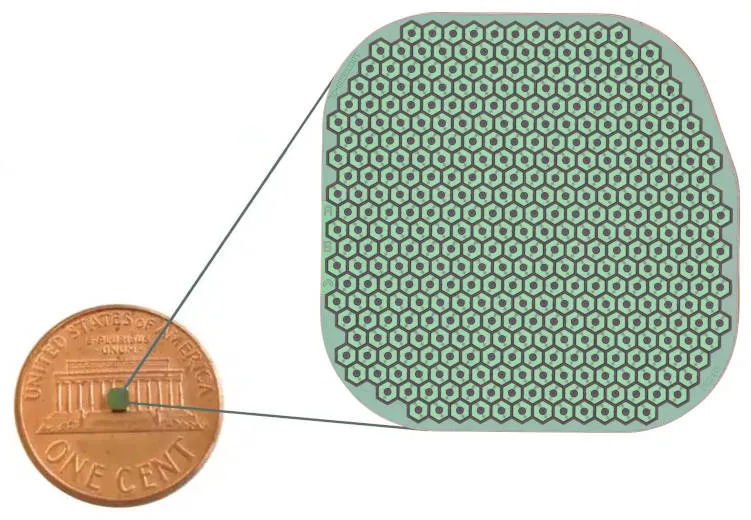
The implant, which works with custom AR glasses and needs no direct electrical connection, is from Californian company Science.
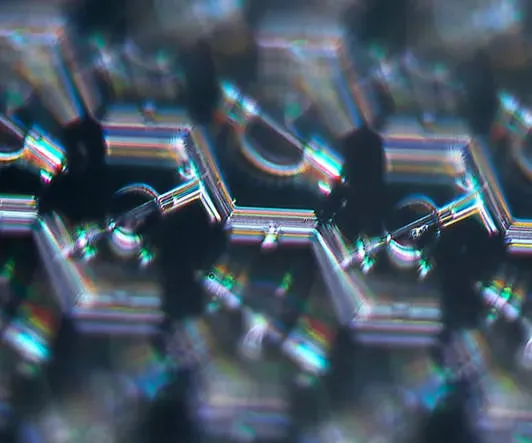
It measures 2 x 2mm and 30μm thick, contains 378 closely-packed hexagonal pixels each 100μm across, and is inserted part-way through the retina, under the damaged rods and cones, on top of the un-damaged electrically-sensitive ‘bipolar’ cells.
Each pixel includes two series-connected photovoltaic cells powering a central electrode, whose counter-electrode runs around the outer edge of the hexagon.
The augmented reality glasses include a camera, a infra-red image projector directed into the eye and, at the end of a cable, a belt-worn image processor that adds features including zoom.
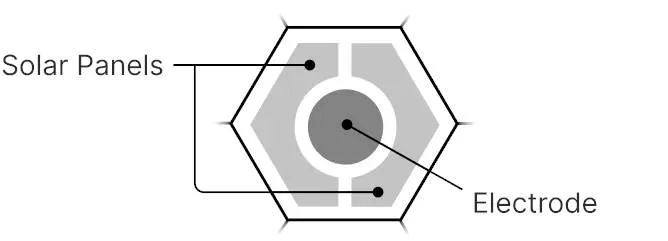 The projected image hits the implant, which converts the infra-red into an identical pattern of electrical stimulation for the bipolar cells.
Published in the New England Journal of Medicine, the trial “showed that 84% of participants were able to read letters, numbers and words using prosthetic vision through an eye that had previously lost its sight due to ‘geographic atrophy with dry age-related macular degeneration’. They could also read, on average, five lines of a vision chart that some participants could not even see before their surgery”, according to Moorfields Eye Hospital in the UK, which was one of the participating institutes.
 In all, 38 people at 17 institutions across five countries took part in the study, which has been published in the New England journal of medicine.
“In the history of artificial vision, this represents a new era,” said Moorfields consultant Mahi Muqit. “Blind patients are actually able to have meaningful central vision restoration, which has never been done before. Getting back the ability to read is a major improvement in their quality of life, lifts their mood and helps to restore their confidence and independence. The PRIMA chip operation can safely be performed by any trained vitreo-retinal surgeon in under two hours.”
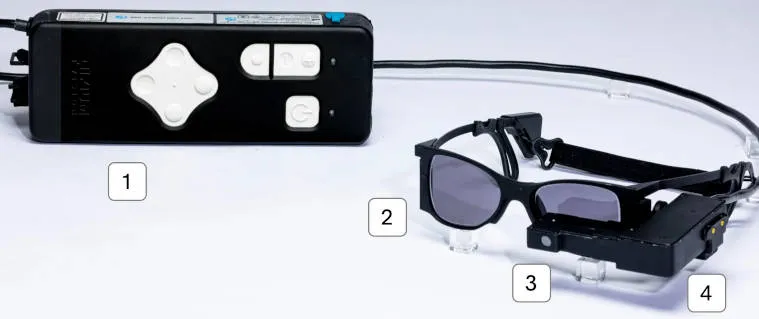 1, processor
2, tinted lenses to cut ambient light
3, camera
4, projector
Update: listening to the one of the trial participants in a BBC Radio 4 In Touch programme, it took hours of training day-after-day to be able to read using this device, after which that participant was delighted with the results.