Spinel is a type of cubic crystal structure, available to certain chemicals of the form AB2X4.
The type identified is (Zn,Mg)Sc2S4, where the balance of zinc and magnesium sets the bandgap and therefore emitted or most-sensitive wavelength: ZnSc2S4 is the orange-emitter, with progressive substitution of magnesium for zinc shifting the wavelength down.
On top of this, the material can be used to form homo-junctions as it can be switched from n-type through insulating to p-type by either replacing a little of the scandium with titanium, or by slightly reducing the zinc content.
Conductivity to be modulated over nine orders of magnitude:
- Undoped ZnSc2S4 is insulating (2.5×10⁻¹¹S/cm)
- ZnSc1.84Ti0.16S4 is an n-type semiconductor (3.7×10⁻⁵S/cm)
- Zn0.9Sc2S4 is a p-type semiconductor (1.8×10⁻²S/cm)
“The sulphide semiconductor identified in this study meets the requirements for both highly efficient light absorbers in solar cells and green light emitters in LEDs, making it a strong candidate for next-generation optoelectronic devices,” claimed team leader Professor Hidenori Hiramatsu, of the Institute of Science Tokyo – to be known as ‘Science Tokyo’.
Hiramatsu focuses on the ‘green gap’ – an efficiency dip in the spectrum fo available LED materials. “Our semiconductor material is suitable for both green emission and photovoltaic applications,” he said.
Science Tokyo worked with the MDX Research Center for Element Strategy
The science
According to Science Tokyo:
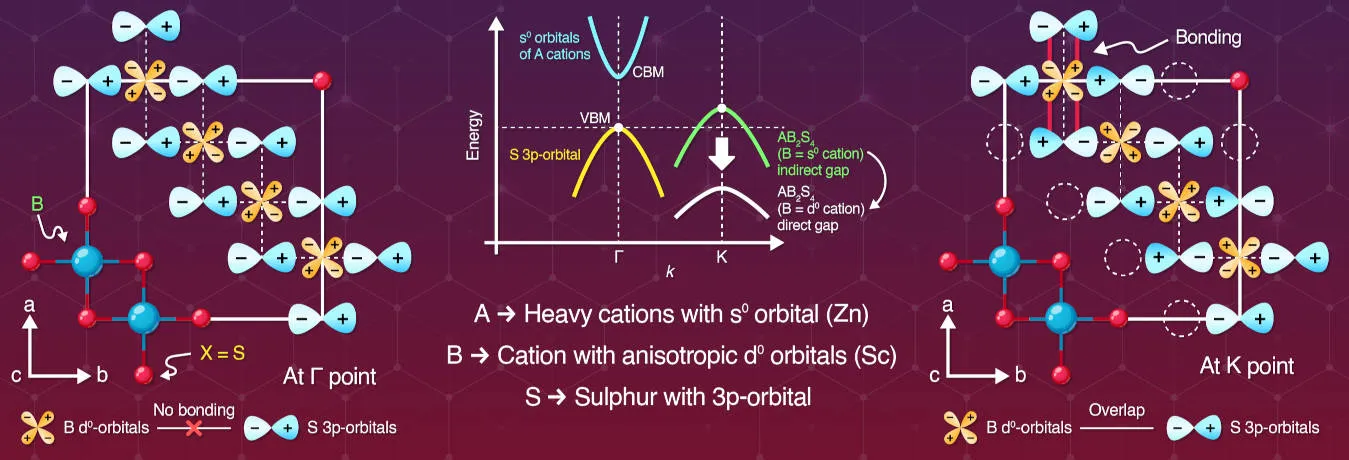
In spinel-type sulphides with the formula AB2S4, the A site is occupied by heavy cations with empty outer s orbital such as zinc, the B site by cations with anisotropic d0 orbitals such as scandium, and the X site by sulphur atoms carrying 3p orbitals.
This arrangement results in a conduction band minimum at the Γ point, derived from the s orbital of the A-site cations, while the valence band maximum arises from shallow non-bonding sulphur p orbitals.
The presence of anisotropic d0 orbitals at the B site further stabilises the band structure by suppressing the valence band at other k-points, thereby ensuring a direct bandgap.
Further information is available in the paper ‘d0 cation-based spinel-type sulfide semiconductors with color-tunable direct-gap and ambipolar dopability‘ in the Journal of the American Chemical Society (abstract only available without payment).
Science Tokyo?
The Institute of Science Tokyo is a new organisation, formed in October last year from the merger of Tokyo Tech (Tokyo Institute of Technology) and the Tokyo Medical and Dental University.
Image credit: Institute of Science Tokyo