
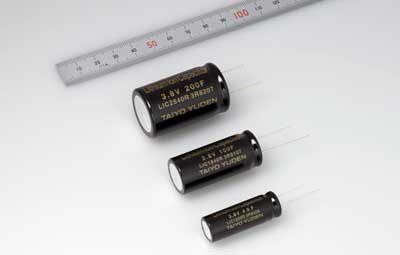
Operation is over -25 to 85℃ (voltage caveats above 70℃), and the firm will offer four versions: 20, 40, 100 and 270F.
“It has superlative safety characteristics,” said Taiyo. “Since the amount of self discharge is small, self-ignition becomes extremely unlikely.”
| Super capacitor | Li-ion capacitor | Li-ion battery | |
|---|---|---|---|
| Operating voltage | 2.7Vmax | 2.2-3.8V (2.5-3.5V at >70℃) |
~2.7 – 3.6V |
| Operating temperature range | -25 to 70℃ | -25 to 85℃ | -20 to 60℃ |
| Electrode material | Activated charcoal | Activated charcoal Carbon-based material |
Li metal oxide Carbon-based material |
| Electrolyte | Organic solvent | Organic solvent | Organic solvent |
| Storage physics | Electrical double-layer | Electrical double-layer Ion doping and de-doping |
Oxidation-reduction reaction |
| Heavy metals | None | None | None |
| Number of recharges | > 100,000 times | > 100,000 times | 1,000 times |
| Relative cap/vol | 1 | 2 | 100 |
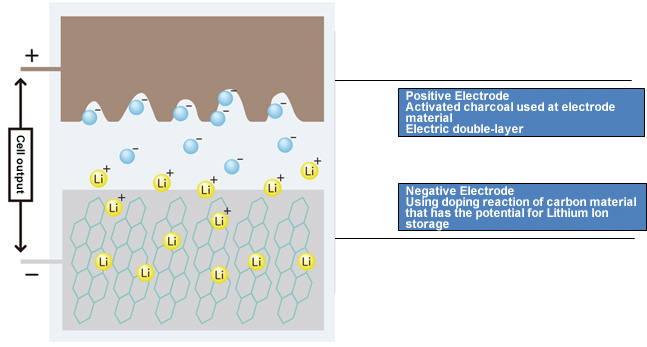 Lithium Ion Capacitors are a type of asymmetric capacitor, where the positive and negative electrodes use different principles.
They have the positive electrode of an electrical double-layer capacitor, which forms an electrical double-layer and is charged and discharged by a physical process, combined with the negative electrode of a lithium ion battery, where lithium undergoes reduction-oxidation (redox) reactions.
“Compared to existing capacitors, the energy density is high, a large reason for this is the fact that the static electricity capacity of the negative electrode is increased by pre-doping,” said the firm – also pointing out that this means the capacitors arrive pre-charged, and capable of delivering high currents into accidental short circuits.
| Part | capacitance F |
diameter mm |
length mm |
dc resistance mΩ |
| LIC1030RS3R8206 | 20 | 10 | 30 | 250 |
| LIC1235RS3R8406 | 40 | 12.5 | 35 | 125 |
| LIC1840RS3R8107 | 100 | 18 | 40 | 60 |
| LIC2540RS3R8277 | 270 | 25 | 40 | 60 |
Really, never discharge below 2.2V
The company has created a comprehensive application note (Notes on circuit design for lithium ion capacitor), and one warning entry reads: “Do not use the product at voltages below the lower limit voltage (2.2V). It may generate gas, causing it to leak, heat up, smoke, explode, or burst into flames. Take due care when designing circuits so that the voltage never falls below the lower limit voltage.”
On the plus side, unlike Li-ion batteries, penetration of the cell is unlikely to cause a fire. According to Taiyo Yuden: “The constituent materials do not contain oxygen, and the chemical reactions that would give rise to thermal runaway cannot occur solely based on Joule heating from the accumulated electrical charge. That means that energy is lost together with the release of electrical charge, and there is no danger of ignition.”
Test results for nail penetration – sideways through the cell – are: no explosion or ignition, and no opening or bulging of the safety valve. Cell surface did reach ~110°C after around two minutes.
 According to product developer Mr Ishida (right), the firm had two use cases in mind Li-ion caps: “The first was to use the high power density to develop a high-volume capacitor for use in energy recovery, or as a back up, for automobiles and industrial machinery The other aim was to develop a low-volume capacitor, that could be used in consumer devices such as smartphones, tablets, mobile phones, digital cameras and PC’s.”
Most of the uses seen so far, according to the firm, is as back-up for rechargeable batteries, delivering high instantaneous power while the battery provides high capacity. Medical appliances is one application, where even momentary voltage drops can be critical. Automotive energy recovery is foreseen, as well as energy recovery in lifts (elevators). “In addition, lithium ion capacitors have started to be used by themselves in a stand alone role instead of rechargeable batteries in some applications,” said the firm.
Other companies making lithium ion capacitors
JM Energy
Vinatech
JSR Micro
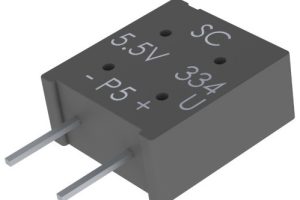
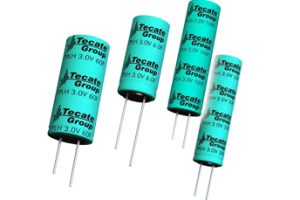

I’ve been taking a look at lithium-ion super capacitors as an alternative to EDLC’s. The claim is that they have a much superior “specific energy” capability. Wikipedia quotes ‘specific energy’ as 11-14 Wh/kG, but then contradicts itself with 20 Wh/kG:
“The packaged energy density of an LIC is approximately 20 Wh/kg, roughly four times higher than an EDLC ….. “
One particular Japanese manufacturer claims 37 Wh/kG for their Li-ion supercap.
Meanwhile the manufacturers of EDLC’s give the ‘energy density’ (I assume this is synonymous with ‘specific energy) of their products as around 4-6 Wh/kG.
Let’s see the numbers:
1) A 100F/3volt EDLC supercap.
Energy stored @ 3.0v = 0.5 X 100F X 3* = 450 Joules.
Typical weight of component = 22 g.
1 Joule = 2.78 x 10⁻⁴ Wh.
Hence energy density is 450/22 = 20.45 J/g. = 20.45 X 2.78 X 10 -4 X 10 +3 = 5.685 Wh/kG
Which agrees with that quoted by the manufacturers, depending on weight (which varies with each manufacturer).
2) Now the lithium-ion hybrid supercap.
A 100F/3.8 volt Li-ion Supercap
The good news: At 3.8 v, these have a higher voltage rating than EDLC’s.
The bad news: They have a lower limit of 2.2 volts, below which de-intercalation takes place and is not recoverable. Therefore only 1.6 v is usable.
Energy stored = 0.5 X 100F X (3.8*2 – 2.2*) = 480 Joules.
Hardly any different from the EDLC type. Assuming the weights are similar – there’s nothing in it. Where is the “four times higher than an EDLC”? Am I missing something?