
Atmel ATA8520D Sigfox tranceiver. For transmit only, pick the ATA8520
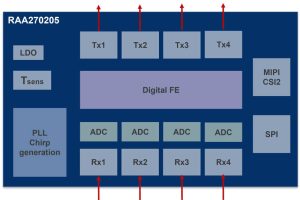
It has an RF front end for up and down-link , a digital baseband and a microcontroller in the same device.
The transmit path uses a closed loop fractional-N modulator, while a serial peripheral interface (SPI) provides for external control and configuration from a host microcontroller.
Firmware stored in internal memory supports the chip’s operations, including handling the Sigfox protocol.
A serial peripheral interface provides for external control and configuration.
It consumes 32.7mA at +14.5dBm output and 10.4mA in receive mode from 2.9-3.1V (‘3V’ mode) or 3.3-5.5V (‘5V’ mode). It shuts down to 5nA (at 25°C).
Uplink data rate is 100bit/s ith differential BPSK modulation, and the downlink is 600 bit/s GFSK.
Industrial and consumer applications include environmental sensors, smart meters, patient monitors, home automation and building security systems.
The package is a 32pin QFN.
ATA8520 is a transmitter-only version of the same IC that works from 1.9 to 3.6V
| Crypto engine: | No |
| Power output | 14.5dBm |
| Antenna diversity | No |
| Max data rate | 100bit/s up 600bit/s down |
| Frequency band | 862 to 872MHz |
| Timers: | 0 |
| Operating voltage | 1.9 to 3.6V |
| EEPROM | No |
| SRAM | 0 |
Mouser is stocking both chips and three evaluation kits, all of which come with an ATA8520D transceiver, temperature sensor, and 868 MHz antenna as well as SIGFOX ID and PAC code:
ATA8520-EK1-E standalone evaluation kit comes with an Atmel ATmega328P microcontroller.
ATA8520-EK2-E extension board is designed for use with an Atmel Xplained Mini development kit or an Arduino Uno R3
ATA8520-EK3-E extension board is designed for use with an Atmel Xplained Pro development kit.