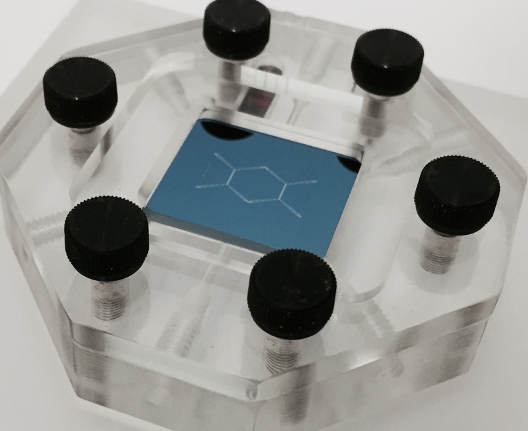
Known as exosomes, these fragments of life are found in bodily fluids such as blood, saliva or urine. Determining the size (this IBM work), surface proteins and nucleic acid cargo of exosomes can indicate the presence and state of developing cancer and other diseases.
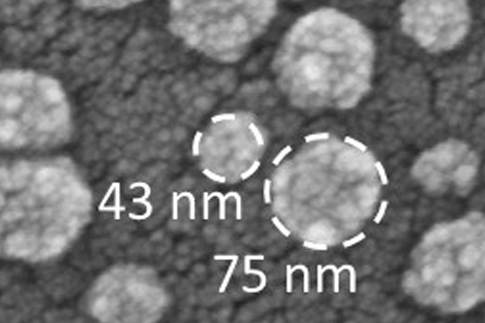 “Until now, the smallest bioparticle that could be separated by size with on-chip technologies was about 50 times or larger, for example, separation of circulating tumor cells from other biological components,” said IBM.
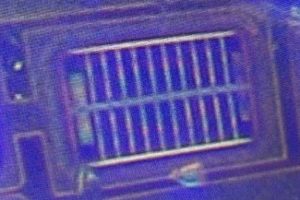
T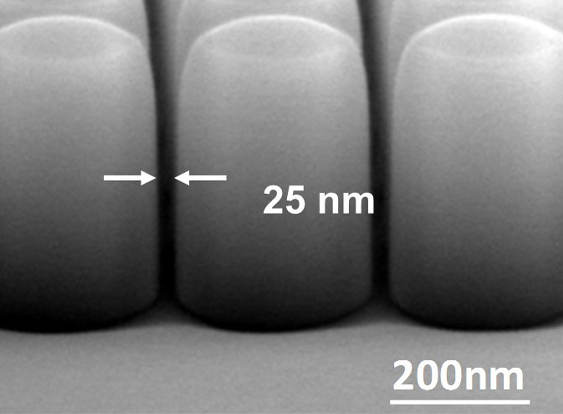 he MEMS is an array of closely-spaced pillars fabricated in silicon, but it is not a simple filter.
Instead is implements a established technique called ‘deterministic lateral displacement’ (DLD).
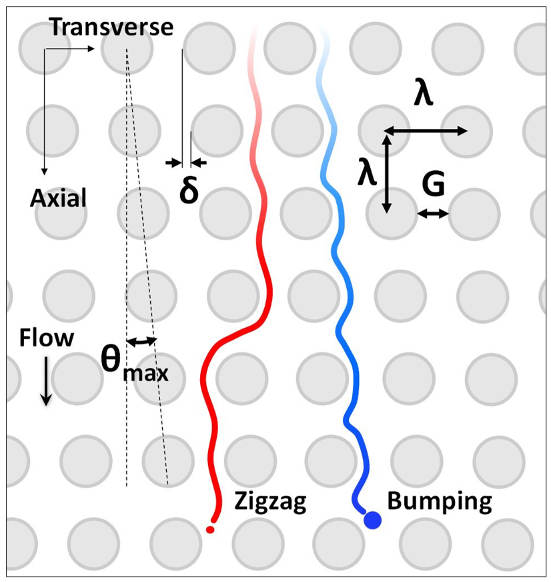 First reported in 2004, DLD involves a large regular array of pillars positioned at a slight angle to a flow of liquid. Providing there is plenty of liquid, hydrodynamic laws cause only particles of a particular size (related to features including pillar size, shape and spacing) to travel smoothly in a straight line between pillars at the angle of the array.
Larger and smaller particles either bounce off pillars or get swept around in slipstreams of individual pillars. On average, these tend to follow the flow direction instead of the array direction.
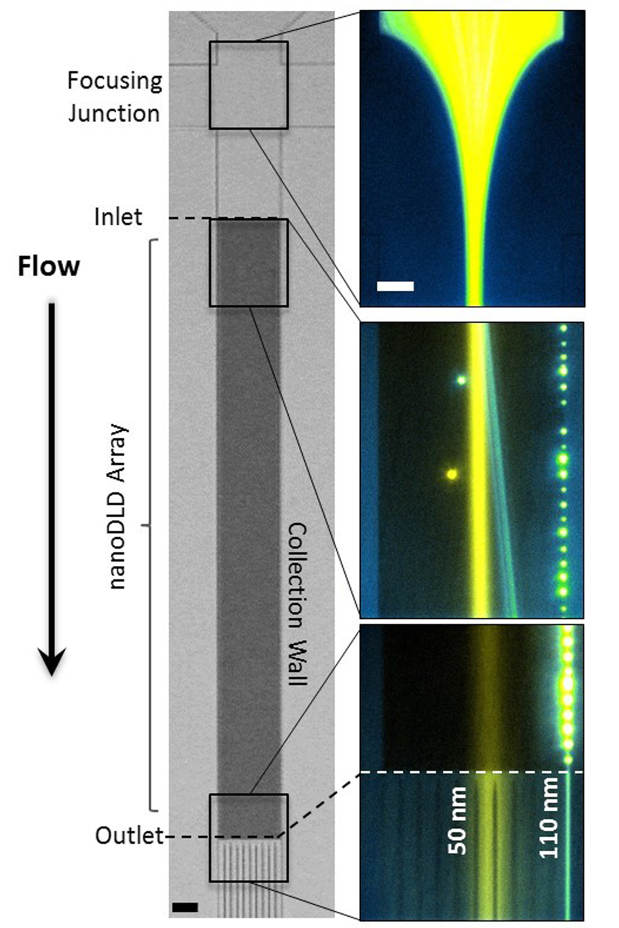 Overall, particles of the critical size gradually move sideways through the length of the array and can be collected at the side, while, for various hydrodynamic reasons, all other particles flow straight on. And, by varying array parameters through the length of a long array, different particle sizes can be picked off at different stages through the array – DLD is described in detail in this excellent Royal Society of Chemistry paper.
IBM is collaborating with a New York medical organisation called the Mount Sinai Health System, where there are plans to test the technique on prostate cancer.
“When we are ahead of the disease we usually can address it well; but if the disease is ahead of us, the journey is usually much more difficult. One of the important developments that we are attempting in this collaboration is to have the basic grounds to identify exosome signatures that can be there very early on before symptoms appear or before a disease becomes worse,” said Dr Carlos Cordon-Cardo from the department of pathology at Mount Sinai.
The researchers are working to increase the diversity of bioparticles that can be separated with their DLD technology, and to fit all of the processes necessary to analyse a disease onto a single chip.
The work is described in ‘Nanoscale lateral displacement arrays for the separation of exosomes and colloids down to 20nm’ in Nature Nanotechnology.