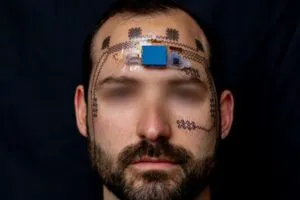
Researchers from the University of Texas at Austin have created a stick-on, thin, flexible, stretchy electrode array that can pick up EEG signals from the brain, which are around 10-times smaller than ECG signals from the heart. On to this is mounted an electronics package that extracts and wirelessly transmits the acquired signals. “Unlike EEG caps that are bulky with ...
ECG
Low-noise medical chip acquires ECG, respiration, blood oxygen and pulse
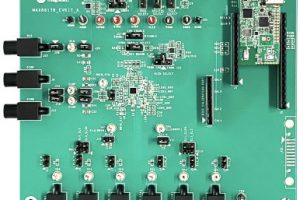
Analog Devices is aiming at wearable patient monitoring devices with an analogue front-end for four vital signs: electrocardiogram, heart rate, blood-oxygen saturation and respiration rate. The chip, MAX86178, does this with three channels, one each for: photodiodes (optical PPG for blood oxygen and heart rate), voltages (electrocardiogram (‘ECG’ or ‘EKG’) and alternative heart rate) and bio-impedance (‘bio-z’ for respiration rate) Optical ...
Nottingham Trent University picks Plessey for smart textiles
Nottingham Trent University is to integrate Plessey sensing technology into car seats to detect sleepy drivers. Plessey has previously demonstrated electrocardiogram (ECG) measurements using its EPIC electrostatic sensing chip, and this work is being extended by the University’s Advanced Textile Research Group. “Plessey has already demonstrated that cardiac signals can be measured unobtrusively using capacitive sensors mounted within the driver’s ...
Microsemi has very low power RF chip for patient monitors
Microsemi has introduced a very low power RF transceiver for short-range wireless applications which draws only 2mA of current when transmiting and receiving data
Plessey buys in to UK medical sensing technology
Researchers at the University of Sussex have developed a contact-less electric potential sensor (EPS) that can image electric fields in real time. Plymouth chip firm Plessey has signed up to manufacture the technology...
IMEC puts heart beat on Android phones
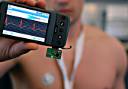
Healthcare costs could be cut by an app for android phones that stores and displays electrocardiograms sensed over a wireless body area network (BAN). Hardware and software have come from consortium of: Belgian Lab IMEC, its Dutch subsidiary Holst Centre, and embedded software firm TASS. “The innovation is a low-power interface that transmits signals from a wireless ECG sensor system ...
Tiny wireless ECG machine can monitor heart in real conditions
Eindhoven-based bio-electronic research lab IMEC-NL demonstrates a miniature wireless ECG machine
Electronics Weekly