Home » Tag Archives: eye

eye

Electronic eye implant for macular degeneration
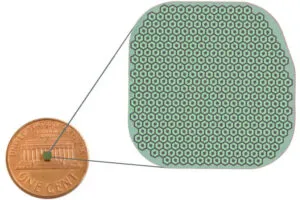
science.xyz Prima visual prothetic scale

Sufficient vision for reading has been restored to volunteers with ‘dry age-related macular degeneration’ in a trial of an electronic eye implant. The implant, which works with custom AR glasses and needs no direct electrical connection, is from Californian company Science. It measures 2 x 2mm and 30μm thick, contains 378 closely-packed hexagonal pixels each 100μm across, and is inserted ...

TRISH eyes eye-tracking to predict astronaut fatigue in real time

nasa-OLlj17tUZnU-unsplash-Edited-700-300x200.webp

HarmonEyes, which specialises in eye-tracking systems, is working with the NASA-funded Translational Research Institute for Space Health (TRISH), an applied research consortium. This will be to deploy H-SMART, its eye-tracking system designed to predict cognitive load and fatigue in real-time. In other words, before it potentially becomes a behavioural safety risk. Antarctica The work with TRISH for astronauts begins later ...

Stretchy electrodes pick up EEG signals

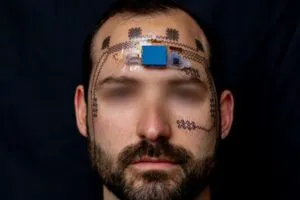
UofTexas at Austin stretchy EEG EOG array credit Device H Huh et al

Researchers from the University of Texas at Austin have created a stick-on, thin, flexible, stretchy electrode array that can pick up EEG signals from the brain, which are around 10-times smaller than ECG signals from the heart. On to this is mounted an electronics package that extracts and wirelessly transmits the acquired signals. “Unlike EEG caps that are bulky with ...

Crab-inspired image sensor works on land and in water over 360°

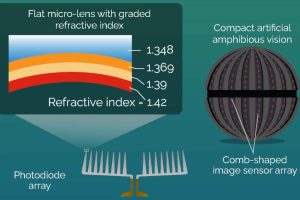
GIST artificial crab eye camera

The eye of the fiddler crab has inspired an artificial image sensor that works on land and in water without refocusing. This crab moves freely between aquatic and terrestrial environments, and to be effective in both its eyes have flat corneas with a graded refractive index profile, according to the Gwangju Institute of Science and Technology in Korea, where the ...

Deep red led light exposure in the morning makes your eyes work better for a while

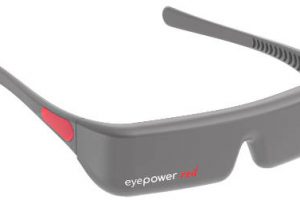
ImperialC EyePowerRed

Three minutes of 670nm exposure in the morning appears to make the eyesight of humans over 40 years old better for a week, according to Imperial College London. The improvement is shown in cone-mediated colour contrast thresholds, tested in people from 37 to 70 years old in this research. Improvements have been seen before, using light at ~40mW/cm2, but this work ...

Infra red LEDs for eye tracking

Osram_Firefly-IR-led

Eye-tracking in virtual reality (VR) and augmented reality (AR) applications are the targets Osram is aiming at with two infra-red LEDs. Eye tracking in VR and AR is there to reduce the discomfort and dizziness felt by some users when virtual and real perceptions do not match. It is implemented by analysing images from a camera directed at the eye, illuminated ...

Efficient polymer photo diodes printed on curved surface

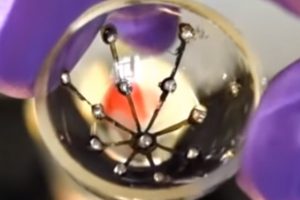
3d-printed-photodiodes-during-print-UofMinnesota-2

Researchers at the University of Minnesota have 3D printed an array of organic light receptors on a hemispherical surface. Starting with a bowl-shaped glass substrate around 20mm in diameter, the team printed a silver nano-particle-based ink, extruding it through a fine nozzle on a custom-made 3D printer – see image. “The dispensed ink stayed in place and dried uniformly instead ...

Be careful with those cool white leds

According to the University of Toledo, it has found a mechanism for a direct link between blue light exposure and age-related macular degeneration. A quick look at the scientific report revealed that when the researchers tried light at 445, 488, 515 and 594nm,  only light at 445nm did any damage. The university is mentions sunlight and screens – phone, tablet ...

Link found between blue light and age-related macular degeneration

Toledo-Karunarathne-blue-light-research-by-Dan

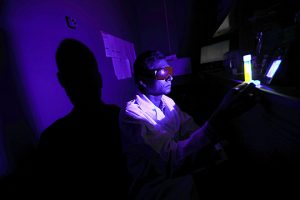
“We are being exposed to blue light continuously, and it’s no secret that blue light harms our vision by damaging the eye’s retina,” said University of Toledo researcher Dr Ajith Karunarathne (pictured). “Our experiments explain how this happens, and we hope this leads to therapies that slow macular degeneration.” The mechanism identified involves a vitamin A related chemical called ‘retinal’ ...