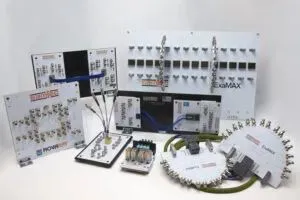
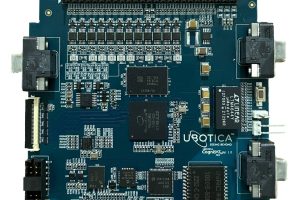
Samtec has released a series of development and evaluation kits for military use. The various kits are designed to simplify and validate designs, from prototype to production stages, based on Samtec’s interconnect products for mil/aero applications using COTS and open standard products. The VITA 57.1 FPGA mezzanine card (FMC) evaluation kits include the FMC extender card and the FireFly FMC ...
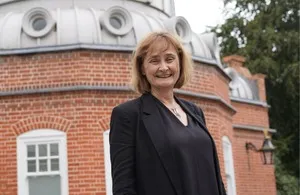
Professor Michele Dougherty, of Imperial College London, has been approved by The King to become the UK’s the new Astronomer Royal. She is the first woman in the role, which dates from 1675, beginning with the aim of determining longitude at sea. It was created by Charles II at the same time as he founded the Royal Observatory in Greenwich, ...
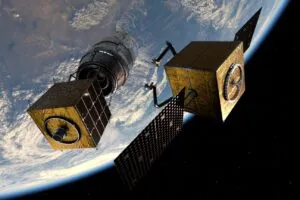
Astroscale – a specialist in satellite servicing and space debris removal – has won a patent for its distributed architecture approach to repeated active debris removal (ADR). Specifically it is the U.S. Patent No. 12,234,043 B2, “Method and System for Multi-Object Space Debris Removal”. Under the patented method, the servicer docks with a debris object (the “client”) and transfers it ...
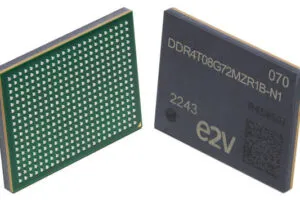
Teledyne e2v has introduced engineering models of its forthcoming 16Gbyte radiation-tolerant DDR4 memory. “With the release of our engineering model, system architects can begin early validation, preparing for a transition to flight-qualified versions,” said Teledyne marketing manager Thomas Guillemain. The memory measures 15 x 20 x 1.92mm and it pad-compatible with the company’s earlier 4 and 8Gbyte DDR4 ICs which ...
In a world where it is no longer a luxury but a necessity, DVB-NIP offers the ability to connect anytime, anywhere, says Rami Moussawi. Whether it’s for streaming entertainment, remote education or running businesses, access to reliable, high-speed connectivity has become as essential as electricity or clean water. Yet, billions of people around the world remain underserved by traditional broadband ...
Space Scotland has appointed Dr. Natasha Nicholson as its new Chief Executive Officer. She played a role in Space Scotland’s early development and now returns to lead the organisation. Dr. Natasha Nicholson has a PhD in astrobiology and has served as Cross-Cluster Liaison Manager for the Science and Technology Facilities Council (STFC) at Harwell Campus. And she was the Chief ...
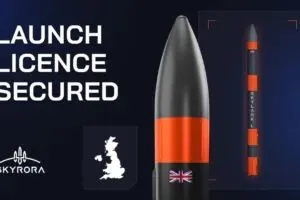
Skyrora has become the first British manufacturer to receive a launch licence for a commercial vehicle. It is for its suborbital rocket Skylark L. CAA The UK’s Civil Aviation Authority (CAA) has awarded the licence to the Edinburgh-based company. It is hoping to launch from the SaxaVord spaceport on Shetland, but the licence covers any UK site. “Becoming the first ...
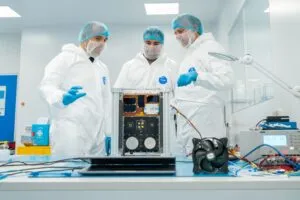
Open Cosmos, the satellite mission services company, is preparing its 6GStarLab satellite for launch. It describes the craft as the first of its kind, a European laboratory to conduct in-orbit 6G experiments. The aim is to enable the experimental validation of new communication technologies in a real space environment. It is due to launch at the end of Q4 year ...
The Space Foundation has released The Space Report 2025 Q2, measuring the global space economy as $613 billion in 2024. This reflects 7.8% year-on-year growth according to the U.S. nonprofit organisation. It underscores, it says, the vital role space plays in “driving economic growth, ensuring national security, and enhancing public safety”. Furthermore, it projects the global space economy could cross ...
Nasa is examining the success of its Dynamic Targeting technology, which uses AI on an Earth Observation (EO) satellite to provide more targeted and valuable science data. Basically, the spacecraft looks ahead along its orbital path and rapidly processes and analyses imagery with its onboard AI. This is to determine where to point an instrument, without any human involvement. The ...